
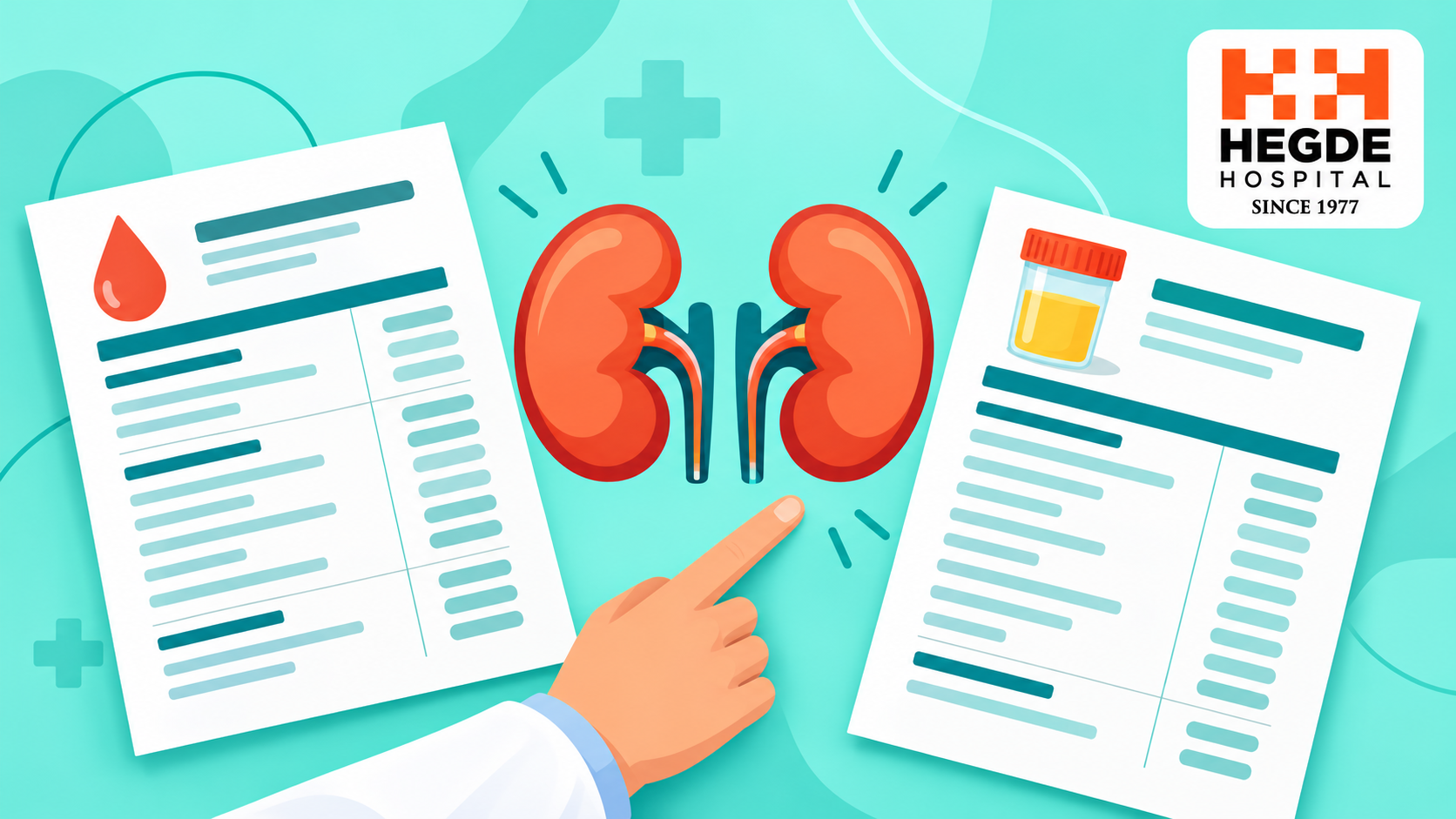
A kidney blood result and a urine albumin result answer different questions. Reading both with earlier reports gives a more useful picture than one number alone.
You may have a blood report labelled “kidney function” and wonder whether a normal creatinine means everything is fine. Or an eGFR value may look lower than expected even though you feel well. The next step is to understand what was actually measured, rather than interpret one highlighted number alone.
Routine kidney assessment often combines a blood filtration estimate with a urine albumin measurement. These are complementary tests. An ordinary blood panel may not include the urine test, so check the names on your report.
The direct answer
Estimated glomerular filtration rate, or eGFR, estimates how well the kidneys filter blood, usually using blood creatinine with age and sex. Urine albumin-to-creatinine ratio, called ACR or UACR, checks for albumin protein in urine relative to urine creatinine.
One estimates filtering function; the other can detect a marker of kidney damage. Neither should be interpreted without the person’s history and previous results. An eGFR number is not a percentage of kidney function.
Who should discuss kidney testing?
People with diabetes, high blood pressure, heart disease or a family history of kidney failure should discuss an appropriate testing plan with their clinician. Early kidney disease may not cause obvious symptoms, so waiting for pain is not a reliable approach.
For diabetes, regular kidney review is important; the exact schedule depends on the type and duration of diabetes, existing findings and the care plan. Diabetes follow-up and blood-pressure confirmation remain separate but related parts of overall care. Do not assume every healthy person needs the same testing package.
What do the tests measure?
Creatinine is a waste product associated with normal muscle activity. Its blood level can be influenced by muscle mass and other factors, so a universal creatinine number does not fit everyone. eGFR uses a calculation to make the filtration estimate more informative, but it still has limitations.
| Report item | What it contributes |
|---|---|
| Blood creatinine | A waste marker used in estimating filtration |
| eGFR | An estimate of filtration, reported in mL/min/1.73 m² |
| Urine ACR or UACR | An albumin measurement adjusted for urine creatinine |
| Previous reports | Evidence about persistence and changes over time |
A normal-looking creatinine does not replace urine albumin testing when it is indicated. Likewise, a urine dipstick is not automatically equivalent to a quantitative ACR measurement. Ask whether both parts of the intended assessment were completed.
What might an abnormal result mean?
A persistently reduced eGFR below 60, or persistent evidence of kidney damage such as elevated urine albumin, can indicate chronic kidney disease. Chronicity generally means that the abnormality has been present for at least three months. A single abnormal measurement does not establish that duration.
An eGFR between 60 and 89 does not by itself establish chronic kidney disease without another marker of damage. Conversely, urine albumin can be elevated even when filtration is preserved. The two tests therefore need to be read together.
ACR may be reported in different units. A value of 30 mg/g or more, or approximately 3 mg/mmol or more in that reporting system, deserves clinical interpretation and usually confirmation when appropriate. Do not compare numbers from different units as though they are identical.
Fever, a urine infection, recent vigorous exercise, menstrual blood contamination and changes in glucose or blood pressure can affect urine albumin findings. The clinician considers these before deciding when and how to repeat the sample. An abnormal result should be reviewed now; the three-month definition is not an instruction to delay care.
How should you prepare?
Ask the laboratory for instructions for the tests actually ordered. ACR often uses a single urine sample, with an early-morning sample useful in many circumstances. It is not automatically a 24-hour urine collection. Tell the team about a current infection, menstruation or recent unusually strenuous exercise.
Blood creatinine and urine ACR alone do not universally require fasting, but other tests booked at the same time may. Follow the laboratory’s instructions and your existing clinician’s advice. Do not alter prescribed treatment or try to change a result by forcing fluids or using a “kidney cleanse.”
What follow-up might be needed?
The doctor compares earlier results, checks blood pressure and health history, and decides whether to repeat the blood or urine test. If the estimate is uncertain because of factors such as unusual muscle mass, another filtration marker may sometimes help. Imaging is selected for a particular question, not automatically added for every mildly abnormal number.
Confirmed findings are assessed for their cause and future risk. The plan may involve the usual physician, a kidney specialist or both. A single number does not tell you that dialysis is needed. Our high uric acid guide explains a different blood result that should not be used as a substitute for this assessment.
How quickly should you seek review?
Arrange routine review of an established stable monitoring result according to your care plan. A newly abnormal result, a clear fall from previous filtration estimates or a laboratory instruction for urgent review should be discussed promptly.
Markedly reduced urine together with significant swelling or breathlessness requires immediate medical assessment. Routine repeat testing should not delay evaluation when someone is acutely unwell.
Common questions
Does an eGFR of 70 mean my kidneys work at 70 percent?
No. eGFR is a filtration estimate with specific units, not a percentage. Age, urine findings and the trend help the clinician interpret it.
Can kidney disease be present with normal creatinine?
Yes, a creatinine result alone can miss part of the picture. Urine albumin or other findings may reveal a concern even when blood filtration appears preserved.
Does one abnormal urine ACR prove chronic kidney disease?
No. Temporary factors and the duration of the abnormality need consideration. The doctor decides whether confirmation is needed and when to repeat it.
Should I wait three months before showing an abnormal report?
No. Show a new abnormal result promptly. Three months describes persistence when classifying chronic disease; it does not define a waiting period for medical advice.
Does everyone need a scan or a 24-hour urine collection?
No. A single-sample ACR is often useful, and imaging is chosen when it answers a specific question. Your clinician should explain what additional testing would change.
Bring both current and older reports to your physician. The metabolic clinic can help review diabetes and blood-pressure risk, and you can request a consultation to choose an appropriate specialist pathway.