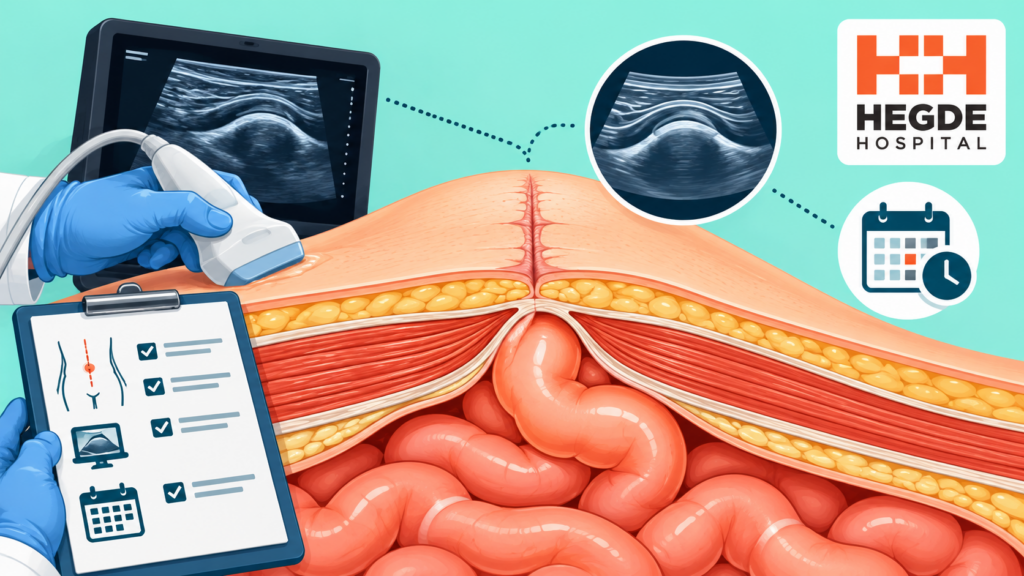

Some hernias can be monitored after a surgeon's assessment, but observation does not close an adult abdominal-wall defect. The type of hernia, symptoms and personal health determine the plan.
You have noticed a groin or belly-button bulge, but it is not very painful. Before agreeing to an operation, you want to know whether hernia treatment without surgery is possible. This is a reasonable question, provided that “no operation now” is not confused with repairing the hernia.
The answer depends on the hernia's location, symptoms and your health. A surgeon can assess whether observation is suitable, whether repair should be planned, and what changes would require another review. A lump should first be examined: not every groin or abdominal swelling is a hernia.
The direct answer
An adult abdominal-wall hernia generally does not close with food changes, exercise or a support belt. Selected patients can choose watchful waiting after assessment, especially some adult men with an inguinal hernia causing little or no discomfort. This is a monitoring decision, not a cure. The same approach should not automatically be applied to women, children or a different hernia type.
What does “without surgery” mean?
A hernia is tissue protruding through a weak area or opening in the wall that normally contains it. When a bulge becomes less visible while lying down, the opening may still be present. Symptom relief or a smaller-looking bulge is therefore not proof that it has healed.
Observation can avoid or defer an operation for a suitable patient. It does not remove the structural defect, and some people later choose repair because symptoms increase. It should include a clear review plan rather than simply ignoring the swelling. Our inguinal-hernia guide explains the common groin type in more detail.
Who may be considered for watchful waiting?
A surgeon may discuss this option with an adult man whose confirmed inguinal hernia causes little or no pain and does not meaningfully limit daily activities. Suitability also depends on examination, overall health, ability to recognize changes and access to timely care. A painless bulge alone does not establish eligibility.
Tell the surgeon about work that involves lifting, travel, care responsibilities and other health conditions. These practical details influence how workable monitoring is. If surgery carries particular risks, the discussion should weigh those risks against the expected course of the hernia.
Why does the hernia type matter?
The phrase “hernia” covers different conditions. Advice for one type may be inappropriate for another. A groin hernia in a woman needs particular attention because a femoral hernia may be present; these are more prone to becoming trapped. Children also need a paediatric surgical assessment rather than adult watchful-waiting advice.
| Situation | Why the decision differs |
|---|---|
| Adult man with a minimally symptomatic inguinal hernia | Monitoring may be an option after assessment |
| Groin swelling in a woman or suspected femoral hernia | The type and risk need prompt surgical clarification |
| Adult belly-button or old-incision hernia | Symptoms, anatomy and individual risks guide the plan |
| Hernia in a child | Age and type determine management; adult advice does not apply |
| Hiatal hernia with reflux | This is an internal hernia with a different assessment and treatment pathway |
Some childhood umbilical hernias close as the child grows, but this should not be generalized to adult abdominal-wall hernias. Our adult umbilical-hernia article covers that separate decision. A hiatal hernia also differs from a visible groin or navel bulge.
Can a belt, exercise or diet repair the opening?
These measures cannot be assumed to close the defect. A support device may be considered by a clinician in selected circumstances for comfort, but it is not a substitute for assessment or repair. Do not buy one on the assumption that it cures the hernia or makes every activity safe.
Ask the surgeon which activities are appropriate for your type and symptoms. A programme that strains the abdomen to “strengthen the hole shut” is not a proven repair. Managing relevant health issues, such as a persistent cough or constipation, may help the broader plan, but does not mean the hernia has gone away.
What should a monitoring plan include?
Before choosing observation, ask what has been diagnosed and why waiting is reasonable in your situation. Agree when to return, who to contact for changing symptoms and how work or exercise should be handled. Note changes in pain, size, daily limitations and whether the bulge behaves differently.
There is no universal number of months or years that makes waiting safe for everyone. A hernia may remain manageable for some time, or discomfort may increase and change the balance toward repair. Review the plan when your health or circumstances change rather than treating an earlier decision as permanent.
When does the plan need an earlier review?
Arrange reassessment if discomfort becomes more frequent, the swelling grows, ordinary activity is restricted or the bulge no longer settles as it previously did. Do not use increasing pain simply as a reason to tighten a support device and continue waiting.
Sudden severe pain, a newly firm or tender bulge, vomiting or difficulty passing stool or gas needs immediate medical evaluation. These changes can indicate trapped tissue. Do not try to force a painful swelling back in yourself.
If repair is recommended, what should you ask?
Ask what the operation is intended to achieve, which approach is appropriate and why. Open and keyhole operations are both surgery. A smaller incision does not make a repair “non-surgical,” and no method is suitable for every patient.
The discussion should cover anaesthesia, expected recovery, persistent discomfort and recurrence risks, along with alternatives. Previous operations and other illnesses can affect the choice. Reading about hernia mesh can help you prepare focused questions, but the decision needs your surgeon's assessment.
Use Hegde Hospital's appointment page to discuss whether monitoring or planned repair fits your confirmed hernia. Bring previous scans or operation records if available.
Frequently asked questions
Can an adult hernia disappear without an operation?
The visible bulge may come and go, but an adult abdominal-wall opening generally does not close on its own. A changing appearance is not proof of healing. The surgeon confirms the type and explains the appropriate plan.
Is watchful waiting suitable for everyone?
No. Evidence for monitoring some minimally symptomatic inguinal hernias in adult men cannot be applied to every hernia. Women, children, other types and increasing symptoms need their own assessment.
Does a hernia belt prevent the need for surgery?
Not reliably. A clinician may consider it for selected symptom support, but it does not repair the defect or remove the need for reassessment. Its suitability depends on the individual hernia.
How long can I safely postpone repair?
There is no universal timeline. Your diagnosis, symptoms, health and ability to obtain care matter. Agree a review plan and report changes rather than choosing a delay from an internet estimate.
Is laparoscopic repair a treatment without surgery?
No. Laparoscopic repair is an operation performed through smaller incisions. It still involves surgical decisions, anaesthesia, recovery and risks that should be discussed before consent.