
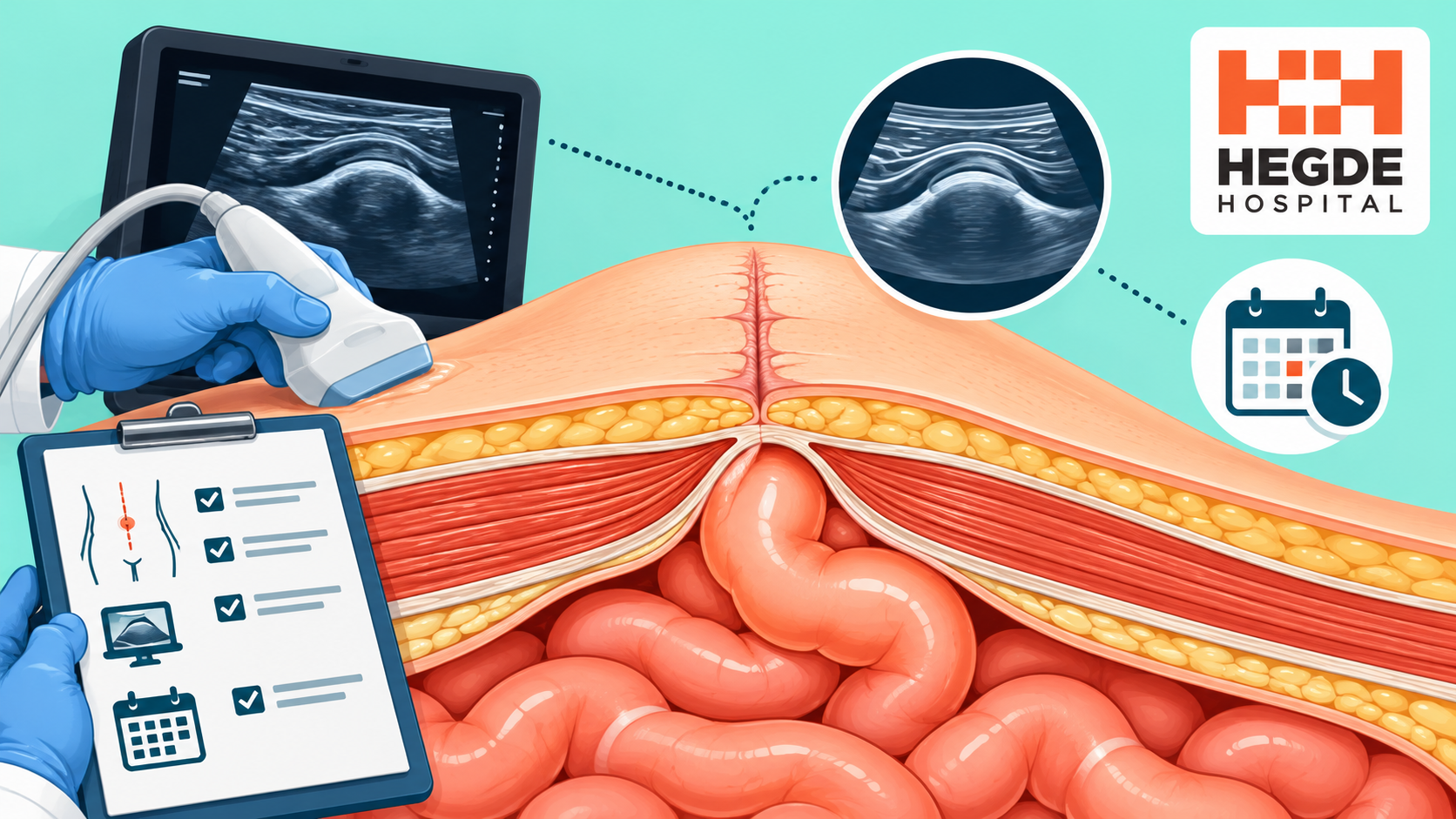
A swelling near a healed abdominal scar needs assessment. The next step depends on whether there is a hernia, its symptoms, the wall defect and your overall health.
An abdominal operation healed months or years ago, but you now notice a bulge beside the scar. It may stand out when you cough or stand and become less obvious when you lie down. You may feel pulling or heaviness rather than sharp pain.
An incisional hernia is one possible explanation. The visible skin can be healed while the deeper supporting layer has a weak area or opening. An examination is needed before assuming that every postoperative lump is a hernia or that another operation is immediately necessary.
The direct answer
An incisional hernia occurs when tissue pushes through a weakness at a previous abdominal incision. It does not generally close on its own. A surgeon may discuss observation for a suitable stable hernia with little or no discomfort, or planned repair when symptoms and the expected benefit justify the risks. Scans help when the diagnosis is uncertain or more anatomical detail is needed for planning.
Why can a hernia appear after the scar has healed?
Healing involves several layers, not just the surface. The deeper abdominal wall has to regain strength after it has been opened. A weakness can become noticeable later as internal tissue bulges through it. Incisional hernias can follow a larger abdominal incision or, less commonly, a small access incision from keyhole surgery.
Wound infection after the earlier operation, smoking, excess weight, diabetes and tissue quality can affect risk. Sometimes several factors contribute. The presence of a hernia alone does not prove that someone caused it by lifting once or that the previous operation was performed incorrectly.
Mention the original procedure, any wound problems and previous hernia repairs. If mesh was used before, the operation note is useful. A surgeon needs this history to understand the abdominal wall and the options now available.
Is every lump near an operation scar a hernia?
No. A fluid collection, firm healing tissue, a localized stitch reaction or another lump may resemble it. Timing matters: new swelling shortly after an operation asks a different question from a bulge developing years later. Your treating team should assess postoperative changes rather than relying on a photograph.
| Finding or situation | What the assessment needs to clarify |
|---|---|
| Bulge that changes with standing or coughing | Whether there is an opening in the abdominal wall |
| Recent swelling near a healing wound | Whether healing changes, fluid or another complication explains it |
| Broad midline ridge rather than a focal lump | Whether muscle separation is present, with or without a hernia |
| Discomfort without an obvious bulge | Whether examination or imaging suggests a hernia or another cause |
Separation of the abdominal muscles, sometimes called diastasis, is not the same as an incisional hernia. They may coexist. Naming either condition from appearance alone can lead to an unsuitable exercise or surgery plan.
What will the surgeon examine?
The clinician asks when the swelling appeared, how it has changed and how it affects work, walking and daily activities. Examination may involve standing, lying down and coughing so the wall can be assessed. The size of the visible bulge is not always the same as the size of the deeper opening.
The assessment also considers skin condition, tenderness, previous scars and whether the bulge settles. Your general health and goals matter: a small swelling that limits daily life can deserve a different discussion from a larger stable hernia that causes little difficulty.
When is ultrasound or CT useful?
An obvious hernia may be identified through examination. Imaging is considered when the diagnosis is unclear or when the surgeon needs to map the defect, its contents, multiple openings or the relationship to an earlier repair.
Ultrasound can answer some questions without radiation. CT is often useful for surgical planning in a larger or more complex incisional hernia; MRI may be an alternative in selected circumstances. These are conditional choices, not a list of tests every patient must undergo.
Bring existing images as well as the written report. Tell the team about pregnancy or the possibility of pregnancy before imaging is arranged. Avoid repeating a scan simply because a second consultation is planned unless the clinician needs new information.
Can observation be a reasonable choice?
For selected patients whose hernia settles back and causes little or no discomfort, watchful waiting may be discussed after assessment. It means an agreed monitoring plan, including when to return and which changes require earlier review. It does not repair the opening, and risk is not zero.
Increasing size, pain, difficulty with everyday activities or changes in the hernia can shift the balance toward repair. The risks of surgery, other illnesses and personal priorities also affect the decision. Findings for one hernia type should not automatically be applied to another; our guide to hernia treatment without surgery explains that distinction.
How is planned repair chosen?
Repair aims to close or reconstruct the defect and strengthen the wall. Mesh is commonly used for incisional hernia repair, but the particular method and mesh position depend on the anatomy, previous surgery, wound conditions and surgeon's assessment. Our hernia mesh guide explains the questions to ask about reinforcement.
Open, laparoscopic and robotic approaches are different ways to perform repair. No approach is best for every patient. Discuss what will actually be repaired, whether a more complex reconstruction is needed, the expected hospital stay and the surgeon's relevant experience.
Potential trade-offs include wound problems, fluid collections, persistent pain, bowel injury and recurrence. Preparation may include help with smoking cessation, glucose control, nutrition and an appropriate weight plan. Preparation should be individualized; a symptomatic hernia should not be left indefinitely without review while a person struggles to reach a target.
What should you expect during recovery?
Recovery varies substantially with the size and complexity of the repair and your health. Early walking and a gradual return to activity are usually encouraged under the surgical team's instructions. Lifting, exercise, driving and physical work need specific advice for your operation rather than a universal return date.
A new postoperative swelling does not automatically mean recurrence, but it should be reviewed if it increases or is accompanied by worsening pain or wound changes. Follow the arranged review and the team's instructions. The general hernia recovery guide provides questions to discuss; complex incisional repair can need a different timetable.
When should the swelling be reviewed?
Arrange a routine surgical appointment for a stable bulge near an old scar. Seek a prompt review for an enlarging swelling, increasing discomfort or new wound concerns. Sudden severe pain, persistent vomiting or a newly firm swelling that no longer settles needs immediate qualified medical evaluation.
Questions patients often ask
Can an incisional hernia appear years after surgery?
Yes. A weakness can become noticeable well after the surface wound has healed. A new lump still needs examination because other conditions can look similar.
If the bulge disappears when I lie down, has it healed?
No. The tissue may have moved back while the deeper opening remains. That change helps the examination but does not establish that observation is suitable for you.
Does every incisional hernia need a CT scan?
No. Examination may be sufficient to identify some hernias. Imaging is chosen when it clarifies the diagnosis or provides information needed to plan repair.
Can a support belt repair the opening?
No. A support garment may be discussed for comfort in selected circumstances, but it does not close the defect or replace a surgical assessment and follow-up plan.
Does keyhole surgery guarantee that the hernia will not return?
No. Recurrence can follow any repair. The defect, technique, tissue quality, wound healing and other health factors all matter, so the choice should be individualized.
Prepare for a useful consultation
Bring your earlier discharge summary, operation note, scan images and a short history of the bulge. Explore Hegde Hospital's surgical services and book an appointment to discuss the diagnosis, observation and the benefits and limits of planned repair.