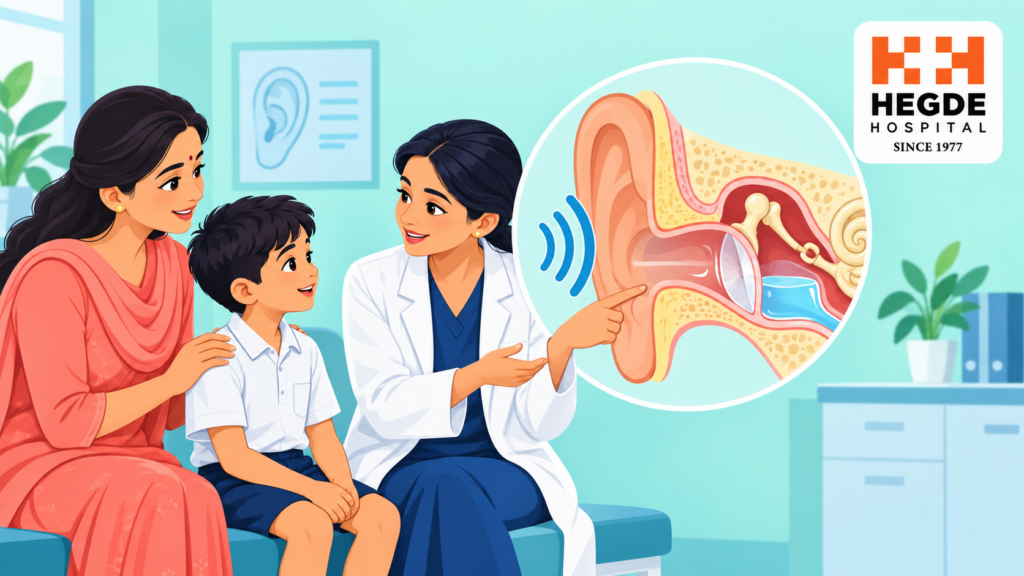

Late talking needs a look at hearing, understanding and everyday communication, not just a word count. Learn what to notice and what a professional assessment may involve.
Your toddler points to the water bottle but rarely uses words, while a cousin of the same age talks in short phrases. Family members may say to wait because someone else spoke late. Comparisons can raise useful questions, but they cannot tell you whether your child needs support.
Speech delay in children should be assessed in the context of hearing, understanding, gestures, social interaction and overall development. Some children need a little support; others benefit from a fuller evaluation. Seeking help does not mean assuming a diagnosis or blaming the family.
The direct answer
If communication concerns persist, arrange a paediatric review rather than waiting for school. The clinician may recommend hearing assessment and a speech-language evaluation. Losing previously used words or other skills, or not responding to sound, deserves prompt review.
A milestone checklist helps describe a concern; it does not diagnose a disorder. The useful question is whether the child is making progress in understanding and communicating across everyday situations. See our broader developmental milestones guide for movement, play and other skills.
How are speech and language different?
Speech is how a child produces sounds and makes words understandable. Language includes understanding what others say and expressing ideas through words or other communication. A child can have difficulty pronouncing sounds while understanding well, or can need support with understanding and using language.
Gestures matter too. Pointing to share interest, looking towards a parent, taking turns with sounds and communicating a need all help the clinician understand the child's development. Counting words without looking at these skills gives an incomplete picture.
Which age-related skills can parents notice?
Children develop at different rates, and the examples below are broad observation points. Discuss a concern at any age instead of waiting until the next row applies.
| Stage | Examples to describe during a review |
|---|---|
| During infancy | Response to voices and sounds, shared smiles and babbling |
| Around the first birthday | Gestures, shared attention and emerging meaningful words |
| During the second year | Growing understanding, more words and communicating needs |
| Around 2 years | Spontaneous two-word combinations and following simple familiar instructions |
| During the preschool years | Longer exchanges and increasingly understandable speech |
Do not treat the table as an examination that the child must perform on command. Write down examples from ordinary play and daily life. A word used meaningfully to communicate tells the clinician something different from a word repeated only from a video.
It is also helpful to notice whether the child understands familiar requests, points to show an interesting object and responds when someone speaks. Tell the clinician when a skill appeared, whether it is used consistently and whether progress seems to have stopped.
Why is a hearing check important?
A child needs access to speech sounds to learn spoken language. Hearing differences can affect language learning, including when the child responds to some loud sounds. A normal newborn hearing screen does not rule out hearing difficulties that develop later.
The clinician may ask about ear problems and recommend assessment by an audiologist, a professional who tests hearing. The type of test depends on the child's age and ability to take part. You do not need to wait for the child to speak fluently before hearing can be assessed.
Hearing assessment and speech-language evaluation answer different questions. One does not replace the other, and hearing care may form part of the support plan when a problem is identified.
Does using Telugu, Hindi and English cause delay?
Growing up with more than one language does not itself cause a speech or language disorder. Children may use words from different languages in one conversation. That mixing is not, by itself, evidence that they are confused.
Tell the clinician which languages the child hears and uses, with whom and how often. Assessment should consider communication across the child's languages rather than judging only English. Families can use the languages they speak comfortably; dropping a home language is not a standard treatment for delayed speech.
If there is a genuine language disorder, it may affect communication across languages. A suitable assessment can use a clinician familiar with the child's language or appropriate interpreting support. The AAP's multilingual language guide explains this distinction for parents.
What can an assessment involve?
The paediatrician asks about birth, health, hearing, development and family observations, then interacts with the child. A speech-language professional assesses understanding, expression, speech sounds and the ways the child communicates. A broader developmental assessment may be advised when other areas also raise concerns.
Possible explanations include hearing difficulty, differences in language development or a wider developmental condition. Late talking alone does not establish autism. The clinician considers social communication and other features before deciding whether further specialist review is needed.
Tests are selected for a reason. A scan, blood test or long investigation list is not automatically needed for every child who talks late. Ask what each proposed assessment will clarify and how the result could change support.
What support may follow?
Support depends on the child's strengths and needs. It may include hearing care, speech-language therapy, developmental services or a planned review with specific goals. Early support can start while the cause is being clarified; families do not always need to wait for a final label before discussing help.
The professional should explain what progress will be reviewed and how the family can take part. Ordinary conversation, shared reading and play may be incorporated into a clinician-guided plan. They are opportunities for communication, not a guaranteed cure or a substitute for assessment.
Avoid pressuring a child to repeat words constantly or comparing performance with siblings. Ask the therapist for activities suited to the child's needs rather than following a generic online programme. Improvement varies, so a fixed promise that every child will catch up in a few weeks is not reliable.
When should parents seek help sooner?
Arrange review when you remain worried about limited progress, unclear speech or difficulty understanding familiar language. Seek prompt assessment for loss of words or other abilities, little response to sound or concern across several developmental areas. Do not explain these signs away solely because someone in the family spoke late.
If communication changes occur suddenly with an acute severe illness, seek immediate qualified medical evaluation. This article concerns developmental communication and does not provide acute-care instructions.
Before the appointment, record a few examples of words, gestures and instructions the child understands. Include observations from a caregiver or preschool, the languages used and relevant hearing records. You can also note separate concerns such as poor weight gain without assuming they share the same cause.
Questions parents often ask
Should we wait because the father spoke late?
Family history can be useful, but it does not establish that waiting is appropriate for this child. A review checks hearing, understanding and wider development so support is not delayed unnecessarily.
Does speech delay always mean autism?
No. Several different factors can affect speech and language. Autism assessment is considered when social communication and other developmental features warrant it; speech delay alone is not a diagnosis.
Can my child need a hearing test after passing the newborn screen?
Yes. Hearing can change after birth, and responding to some sounds does not exclude all hearing difficulty. The clinician decides whether a current assessment is needed for the communication concern.
Should we speak only English to help the child?
No. Use the languages you communicate in comfortably and tell the assessor about all of them. Multilingual exposure does not itself cause a language disorder, and support should consider the child's full communication environment.
How long will speech therapy take?
There is no single timetable. It depends on the child's needs, any underlying difficulty and the support plan. Ask for review points and meaningful communication goals rather than a guaranteed deadline.
Arrange the right review
Check Hegde Hospital's services and request a child-health appointment with examples of the concern. The first useful outcome is an assessment plan covering hearing, language and development, followed by support appropriate to your child.