
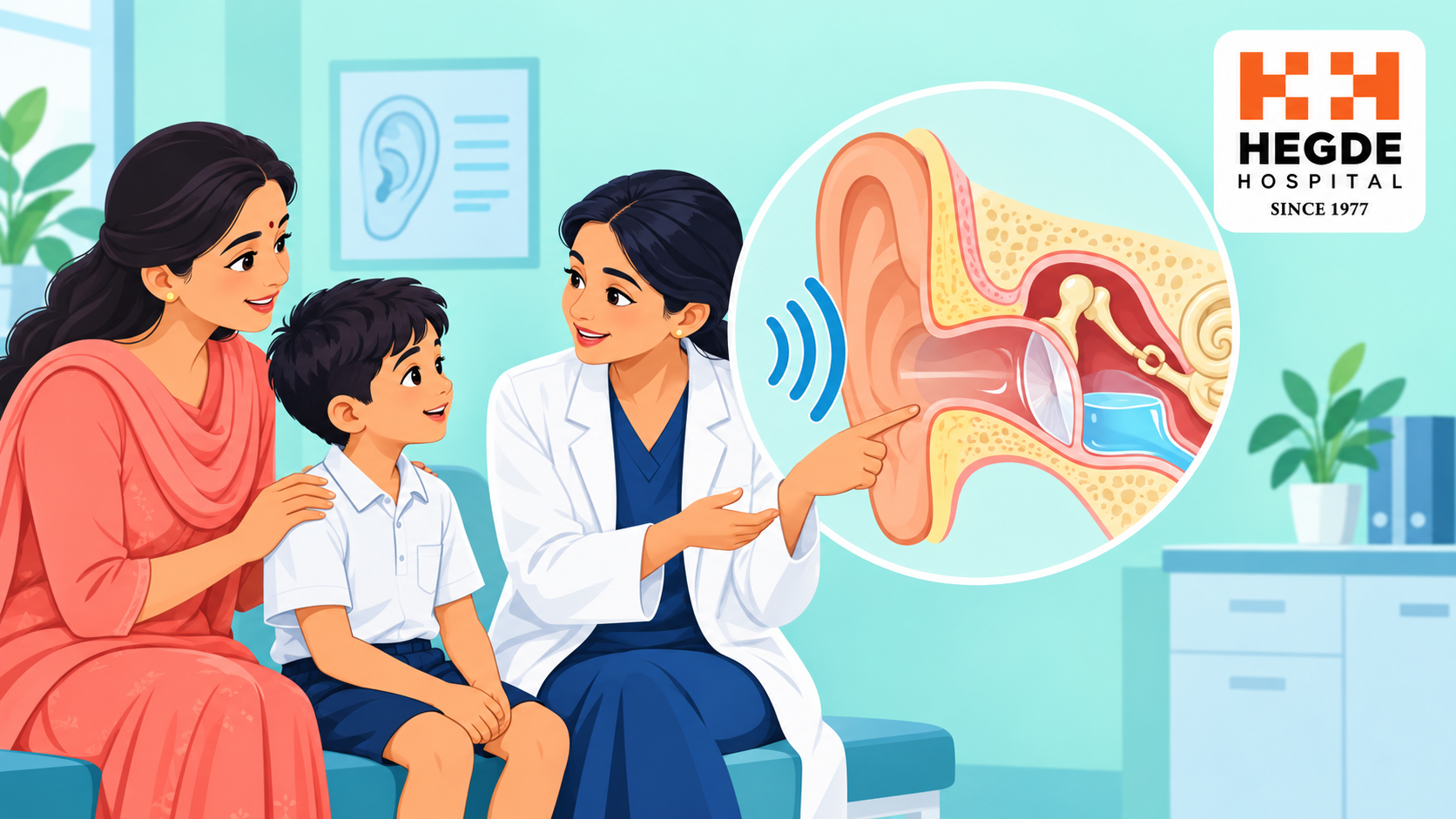
Fluid behind the eardrum can make a child hear less clearly without obvious fever or pain. Hearing checks and the effect on daily life guide the next step.
Your child asks “what?” more often, turns the television up or seems to miss instructions at school. It may look like inattention, especially when there is no fever or obvious ear pain. Hearing is worth checking before assuming that the child is choosing not to listen.
One possible cause is glue ear: fluid in the space behind the eardrum. The name does not mean that glue or bathing water has entered the ear, and an examination is needed to confirm the cause of hearing difficulty.
The direct answer
Glue ear, also called otitis media with effusion, can reduce hearing when fluid collects in the middle ear without the usual signs of an acute infection. It may affect one ear or both and can fluctuate. Assessment combines an ear examination, age-appropriate hearing tests and a test of eardrum movement when appropriate. Many cases improve over time, but monitoring needs a review date and support for communication.
What might parents and teachers notice?
A child may speak loudly, need instructions repeated or find conversation harder in a noisy room. Younger children may be less clear in their speech; older children may seem tired or distracted during listening tasks. Some have ear discomfort or balance difficulties, while others do not complain about their ears at all.
These signs are not specific to glue ear. Earwax, another ear condition or a different type of hearing loss can also affect hearing. Speech delay deserves a broader developmental and hearing assessment rather than being attributed to fluid alone.
Is it the same as an ear infection?
| Situation | How assessment differs |
|---|---|
| Glue ear | Fluid behind the eardrum with hearing difficulty that may fluctuate; high fever is not a defining feature |
| Acute ear infection | Pain, fever or an unwell child may need a different and more prompt assessment |
| Earwax or another blockage | Examination checks the outer ear canal as well as the eardrum |
| Another cause of hearing loss | Formal hearing assessment helps avoid overlooking a coexisting problem |
Fluid can remain after an infection has settled, but not every child with glue ear has a recent infection. The eustachian tube, which helps ventilate the middle ear, can work less effectively in children. Nasal and adenoid problems may also be relevant in selected cases.
What happens at the hearing assessment?
A clinician asks about hearing changes, previous ear problems, speech, school and the effect on family life. Examination checks the ear canal and eardrum. An audiologist can assess hearing using methods suited to the child’s age and development; the child does not have to be old enough for an adult-style hearing test.
Tympanometry measures how the eardrum responds to pressure changes and helps assess the middle ear. It is different from a hearing test: one does not replace the other. Reports need to be interpreted alongside the examination and the child’s everyday difficulties.
Tell the team about an existing hearing impairment, cleft palate, Down syndrome or other developmental concerns. These can affect the monitoring and referral plan. If there is also persistent snoring, mention it rather than assuming the problems have a single cause.
Does monitoring mean waiting without help?
No. For glue ear with hearing loss in both ears, hearing is often reassessed after about three months. A review at a similar interval may be considered when one ear is affected. Significant effects on communication, learning or daily life can justify earlier intervention; the three-month interval is not a reason to delay an initial hearing check.
During monitoring, the team should explain how to support communication. Face the child when speaking, gain their attention first and reduce background noise where possible. Let teachers know about the hearing difficulty so seating and instructions can be adapted. These are communication supports, not remedies that remove middle-ear fluid.
When are hearing devices or grommets considered?
Options depend on hearing-test findings, duration, day-to-day effects and family preferences. Temporary hearing devices may help some children. Grommets are small ventilation tubes placed through the eardrum during a procedure. A specialist should explain expected benefits, anaesthesia and risks such as discharge, infection or a persistent opening in the eardrum.
Selected children may be offered a supervised technique to improve middle-ear ventilation, if they can participate. Do not improvise pressure manoeuvres at home. Adenoid surgery is a separate specialist decision and is not automatically required for every child with fluid.
Routine medicine courses and home remedies do not provide a reliable solution for uncomplicated glue ear. A new infection, if present, needs its own assessment. Follow-up remains important after treatment because hearing can change and fluid may return.
When should the child be seen sooner?
Arrange a routine hearing assessment for repeated listening difficulties, concerns from school or speech changes. New ear pain, discharge, fever or a worsening hearing problem needs prompt medical review. Sudden hearing loss or a very unwell child requires immediate medical evaluation rather than waiting for a scheduled fluid review.
Questions parents ask
Can glue ear occur without pain?
Yes. Hearing difficulty may be the main sign, with no obvious pain or fever. This is why changes noticed at home or school matter.
Should we wait three months before asking for a hearing test?
No. Seek an assessment when hearing is a concern. A later monitoring interval is chosen after the initial findings are known.
Does fluid mean bathing water entered the ear?
Usually not. Glue ear affects the middle-ear space behind the eardrum. It is different from water or wax in the outer ear canal.
Will every child need grommets?
No. Some improve with monitoring, while others benefit from hearing support or a procedure. The decision depends on hearing and everyday effects, not the name alone.
Can hearing problems explain all speech delay?
No. Reduced hearing can contribute, but speech or developmental concerns may have other causes. A broader assessment may still be necessary.
Bring school observations and previous hearing reports to the paediatric service or arrange an appointment. The next step is to establish what the child hears and agree on support and a review date.