
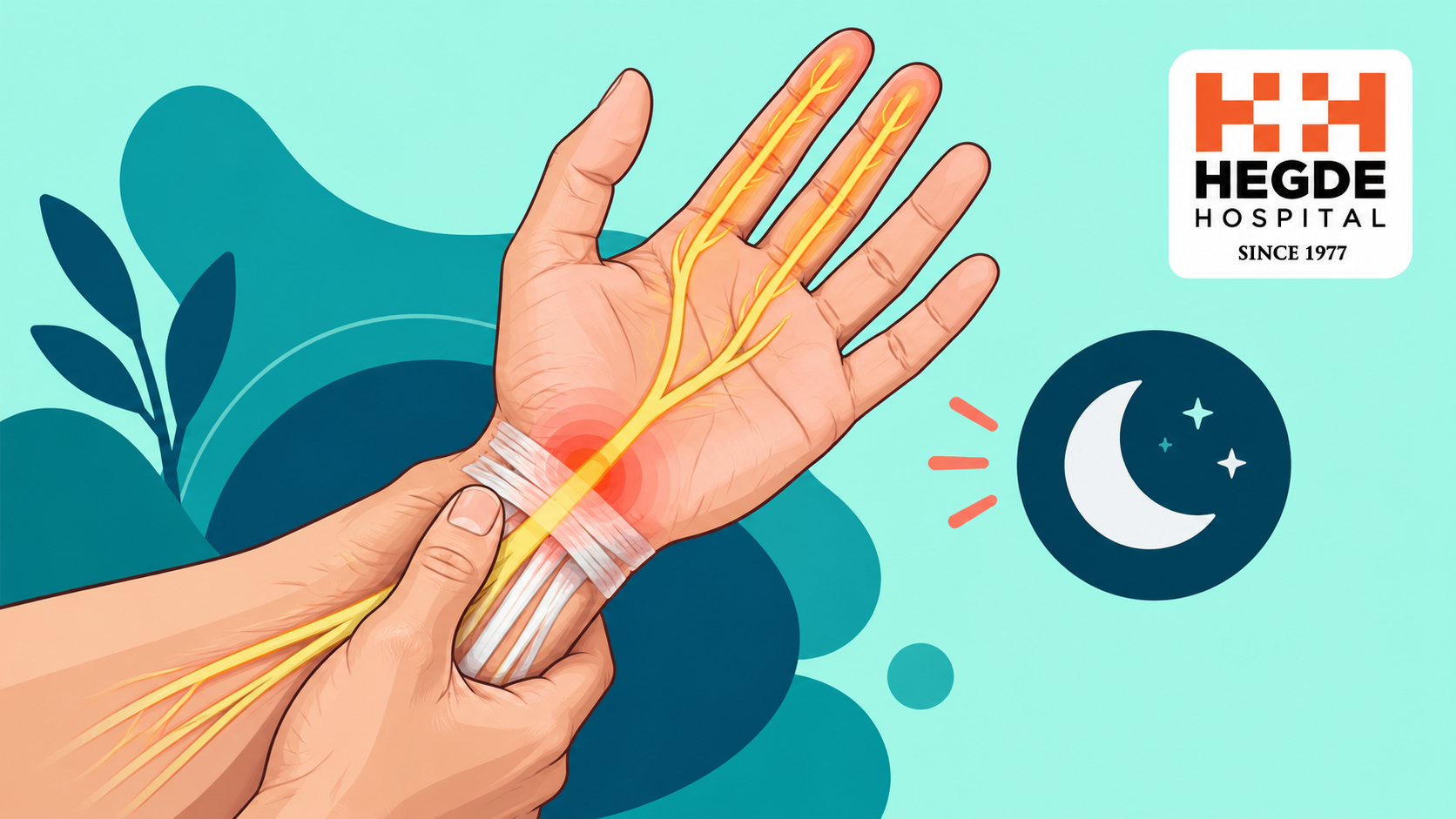
Tingling in the thumb and nearby fingers can disturb sleep and make grip feel unreliable. Learn when the pattern suggests wrist nerve compression and how it is assessed.
Your thumb and fingers tingle at night, or a cup feels less secure in your hand. Symptoms may settle for a while and then return when you hold a phone or work with your wrist bent. Repeated numbness deserves an assessment rather than being attributed automatically to tiredness.
Carpal tunnel syndrome is one possible explanation. Problems elsewhere in the arm or neck can cause similar symptoms, so the affected fingers, timing and examination all matter.
The direct answer
Carpal tunnel syndrome occurs when the median nerve is compressed as it passes through a narrow space at the wrist. Tingling often affects the thumb, index and middle fingers and the thumb-side half of the ring finger, particularly at night. A clinician can often diagnose it from the history and examination; nerve tests or imaging are used selectively. Treatment depends on severity and whether the nerve shows weakness or lasting sensory change.
Which symptoms fit the pattern?
Symptoms can come and go initially. They may wake you from sleep, occur during sustained gripping or make small tasks such as fastening buttons harder. Some people drop objects because sensation or thumb strength is reduced. Either one hand or both hands may be affected.
The little finger is not the usual median-nerve territory. Numbness affecting a different pattern, neck pain or symptoms extending beyond the hand should be described clearly. Pain alone is not enough to identify carpal tunnel syndrome.
| What you notice | Why the detail helps |
|---|---|
| Thumb, index and middle finger tingling | Fits the usual median-nerve distribution |
| Symptoms mainly at night | A common feature, although not diagnostic alone |
| Little finger symptoms or neck-related pain | May point to another or an additional cause |
| Constant numbness, weak grip or thumb muscle thinning | Needs a timely assessment of nerve function |
Is typing always the cause?
No. Wrist anatomy, repeated forceful hand use, sustained wrist positions, pregnancy-related changes and certain health conditions can contribute. Having diabetes or a thyroid disorder can be relevant, but does not prove the reason for your symptoms. Many people have several contributing factors rather than one clear cause.
A clinician may review relevant thyroid symptoms or existing health records when the history suggests a connection. Broad blood-test panels are not necessary for every person with tingling. Describe your actual work tasks rather than assuming that a computer is responsible.
What will the doctor examine?
The assessment includes sensation, thumb strength, muscle bulk and the effect of certain wrist positions or gentle pressure over the nerve. The doctor may examine the neck and elbow if the symptom pattern suggests another source. A single home manoeuvre cannot reliably establish the diagnosis.
Bring information about which fingers are affected, how often sleep is disturbed, whether symptoms are becoming constant and whether you drop objects. Mention pregnancy, previous wrist injuries and current health conditions. Distinguishing wrist nerve symptoms from outer elbow tendon pain helps avoid treating the wrong structure.
When are nerve tests or scans helpful?
A nerve conduction study measures how electrical signals travel through the nerve. In selected cases, additional muscle testing helps assess nerve or muscle damage. These tests may clarify an uncertain diagnosis, assess severity or help plan treatment when the findings are complex.
Ultrasound can be useful in some situations. An X-ray assesses bone-related questions rather than diagnosing the nerve compression itself. MRI is not a routine requirement for every typical presentation. Ask what a proposed test will change in the care plan; a longer test list is not automatically a more useful assessment.
What treatment choices may be discussed?
For milder symptoms without significant nerve damage, a clinician may recommend a properly fitted wrist splint and changes to activities or work positions that aggravate the problem. A therapist can advise on an individual rehabilitation plan. The fit, duration and follow-up should be explained rather than copied from another patient’s treatment.
Other clinician-delivered treatments may provide temporary relief in selected cases. Persistent symptoms, worsening weakness, constant numbness or evidence of significant nerve impairment can lead to a discussion about surgical release. The operation creates more space for the nerve. The decision should account for the examination, test results where needed, previous care and your priorities.
What should I expect from recovery?
Relief of night symptoms and recovery of sensation or strength do not always happen at the same speed. Long-standing or severe nerve changes can recover slowly and may not reverse completely. Neither splinting nor an operation comes with a guaranteed result.
Discuss hand use, driving, work demands and the timing of follow-up with the treating team. Heavy manual work and light desk work may need different plans. Progress should be judged by useful function and symptom change, not only by how a wound looks.
When should I seek medical review?
Book an assessment for repeated tingling, sleep disruption or unreliable grip. Seek prompt review for constant numbness, increasing weakness or visible loss of thumb muscle bulk. Sudden arm weakness with facial or speech changes requires immediate medical evaluation; it should not be assumed to be a wrist problem.
Questions patients ask
Can carpal tunnel affect both hands?
Yes. Both hands can be affected, sometimes to different degrees. The examination still needs to consider other causes and the severity in each hand.
Is every numb hand carpal tunnel syndrome?
No. Other nerve problems, neck conditions and several health disorders can cause numbness. The distribution of symptoms and examination guide the diagnosis.
Must I have a nerve conduction test before any treatment?
Not always. A typical history and examination may be enough for initial care. Testing is more useful when the diagnosis, severity or treatment decision is uncertain.
Does an operation restore sensation immediately?
Not necessarily. Recovery depends partly on the extent and duration of nerve impairment. Some symptoms improve earlier than strength or constant numbness.
Can I keep working while being assessed?
This depends on symptoms and job demands. Ask for an individual plan, especially if reduced sensation or grip could make a task unsafe.
Use the appointment service to arrange the appropriate clinician. A record of affected fingers and daily tasks is a useful starting point for deciding what to test and what to change.