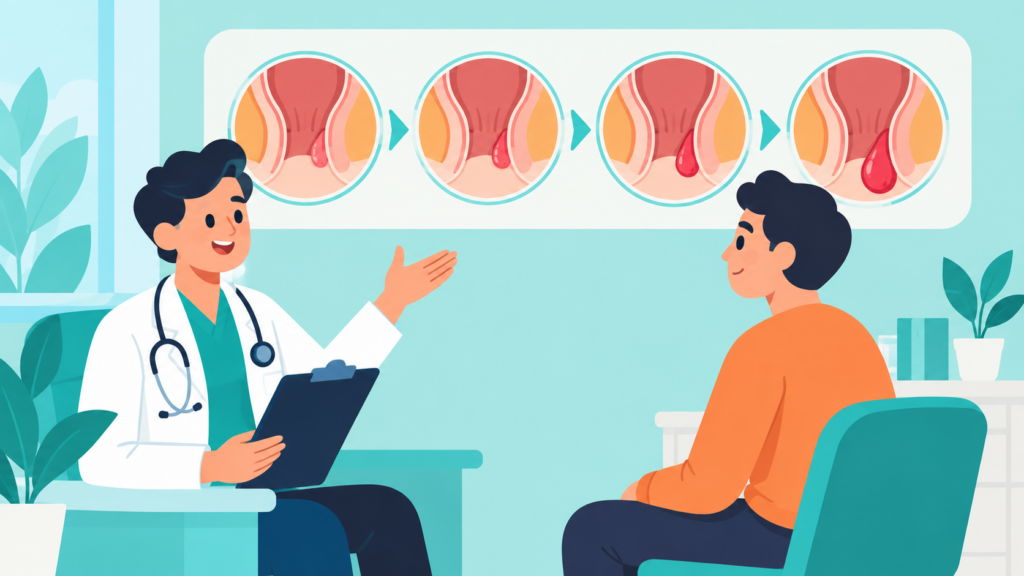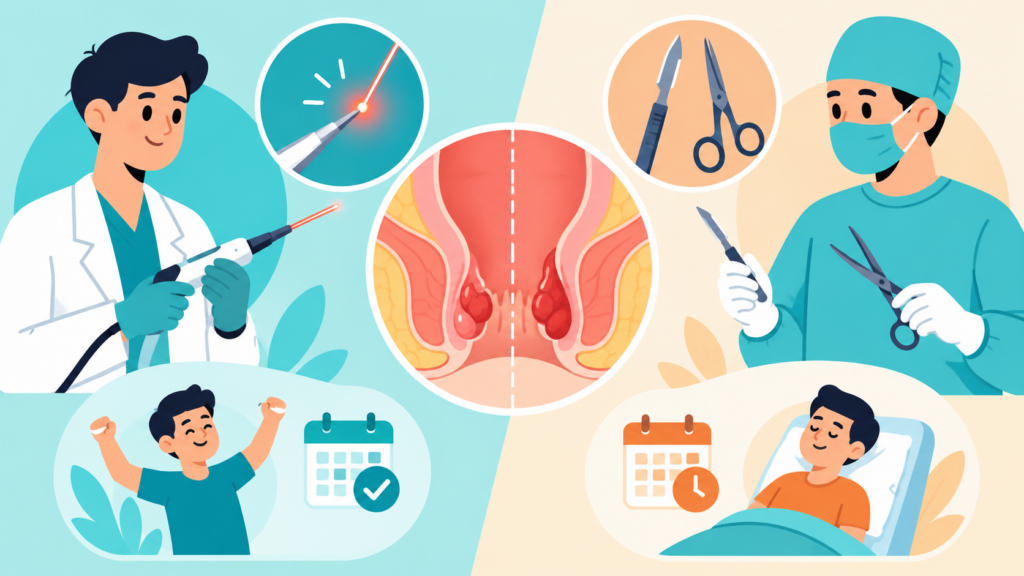

Many people with piles can begin with treatment that does not involve an operation. The choice depends on examination, symptoms and whether piles are internal or external.
Being told that you have piles does not automatically mean you need an operation. If bleeding, irritation or a swelling keeps returning, the useful question is which treatment fits the condition found on examination.
Piles treatment without surgery can mean conservative care or a procedure performed in a clinic. These are different choices. A clinic procedure is still medical treatment, with possible discomfort and complications; “without surgery” does not mean risk-free or suitable for everyone.
The direct answer
Many people can begin with bowel-habit and food changes, with symptom treatment chosen by a clinician when appropriate. Suitable internal piles may be treated with an office procedure if conservative care is not enough. Large external piles, substantial prolapse or persistent symptoms may need a discussion about surgery.
The first step is to confirm the cause. Rectal bleeding or anal pain should not be assumed to be piles. This guide explains treatment choices after assessment, rather than offering a way to diagnose yourself or guarantee that an operation can be avoided.
Why examination matters before choosing treatment
Internal piles are inside the anal canal; external piles are at its outer edge. Some people have both. Internal piles may bleed or protrude, while a painful outer swelling asks a different treatment question. A fissure or another bowel condition can produce symptoms that people attribute to piles.
A clinician asks about bleeding, bowel habits, pain, how often symptoms occur and whether tissue comes outside. Examination may include looking at the area and using a small instrument to view the anal canal. Further bowel investigation is considered when the history or examination makes it appropriate; not everyone needs the same tests.
Our piles, fissure and fistula comparison explains why these names should not be used interchangeably. New or recurring bleeding deserves a clear assessment even if you have had piles before.
What does conservative treatment involve?
The aim is to reduce straining and improve stool consistency. A balanced eating pattern with fibre-containing foods, suitable fluid intake and more useful toilet habits can reduce symptoms for many people. Food changes should suit existing dietary or fluid restrictions.
Avoid repeatedly postponing bowel movements, pushing for a long time or sitting on the toilet longer than needed. Discuss ongoing constipation or frequent loose stools with the clinician because both can complicate symptoms. Simply increasing fibre rapidly may add bloating, so food changes should be gradual and practical.
A clinician may recommend symptom care after assessing you. Some treatments provide temporary relief rather than correcting protruding tissue. Do not keep changing products on your own while bleeding continues. Our piles-diet guide covers the separate food intent; dietary change is not a guaranteed cure for every form of piles.
What are the clinic procedures?
For selected internal piles, office-based treatment may be considered. The choice depends on the extent of protrusion, symptoms, previous treatment and health history. Tell the clinician about prescribed treatments and conditions that can affect bleeding or healing; do not stop them yourself.
| Option | General purpose | Important limit |
|---|---|---|
| Rubber-band ligation | A clinician places a small band on suitable internal tissue to reduce its blood supply | Not a treatment to apply at home and not used for external piles |
| Injection-based treatment | A clinician injects a substance intended to shrink suitable internal tissue | Eligibility and aftercare depend on the clinical assessment |
| Coagulation methods | Controlled energy is used on selected internal tissue | The extent of disease and symptom pattern affect suitability |
These procedures are not all interchangeable. Ask why a particular method is recommended, what benefit is expected and what alternatives exist. More than one session or later treatment may be needed. No method guarantees that symptoms will never return.
How do piles grades affect the decision?
Internal piles are often described by how far they protrude and whether they return inside. Early grades are commonly considered for conservative treatment and, when necessary, office procedures. Some selected cases with more protrusion may also be suitable for an office approach.
The grade is only one part of the decision. External disease, bleeding, pain, daily-life impact and previous response also matter. Read the piles-grades guide for that separate classification question. A number alone should not be used to choose a procedure from an advertisement.
When might surgery be discussed?
Surgery may be appropriate when there is substantial external disease, combined internal and external piles, persistent protrusion, or symptoms that remain troublesome despite suitable earlier care. It is a discussion about the expected benefit and risks for your condition, not proof that previous treatment was a mistake.
Ask whether delaying a procedure changes the plan and what follow-up will show whether conservative care is helping. A “laser” label does not by itself establish that treatment is non-surgical, painless or superior for every patient. The exact procedure and its purpose need to be explained.
How can you judge whether the plan is working?
Record bleeding frequency, pain, protrusion and whether bowel movements have become easier. Bring that pattern to follow-up. Less itching does not necessarily mean the bleeding source has been confirmed or the prolapse has resolved.
There is no universal recovery date or review interval. A clinic procedure may need specific aftercare and contact instructions. Ask what symptoms are expected and what should lead you to contact the team sooner. Follow those instructions instead of relying on a general online timeline.
When should you seek review sooner?
Arrange a review for new or repeated bleeding, worsening swelling or symptoms that affect everyday life. Persistent bleeding despite treatment should be reassessed rather than automatically blamed on piles.
Heavy ongoing bleeding, faintness or severe worsening pain needs immediate qualified medical evaluation. This article does not provide emergency treatment instructions.
Frequently asked questions
Can all piles be treated without an operation?
No. Many can begin with conservative care, and some internal piles are suitable for office procedures. The examination and response to treatment determine whether surgery should be discussed.
Is rubber-band treatment suitable for external piles?
No. It is used for selected internal piles. A painful external swelling needs its own clinical assessment; do not attempt band treatment yourself.
Does symptom relief mean piles are permanently cured?
No. Symptoms may improve while the tendency to recur remains. Follow-up and useful bowel habits help guide longer-term care, but no plan guarantees zero recurrence.
Is laser treatment always non-surgical?
No. The term describes a technology, not every aspect of a procedure. Ask what will actually be done, whether anaesthesia is involved and which alternatives fit your condition.
Should I ignore small amounts of blood if I already have piles?
No. New, recurring or persistent bleeding needs review. A previous piles diagnosis does not explain every later episode of bleeding.
Discuss the options for your condition
Use the services directory or doctor directory to find appropriate surgical care, and book an appointment. Bring a short symptom history and details of previous treatment. The goal is an explained plan with realistic benefits, limits and follow-up.