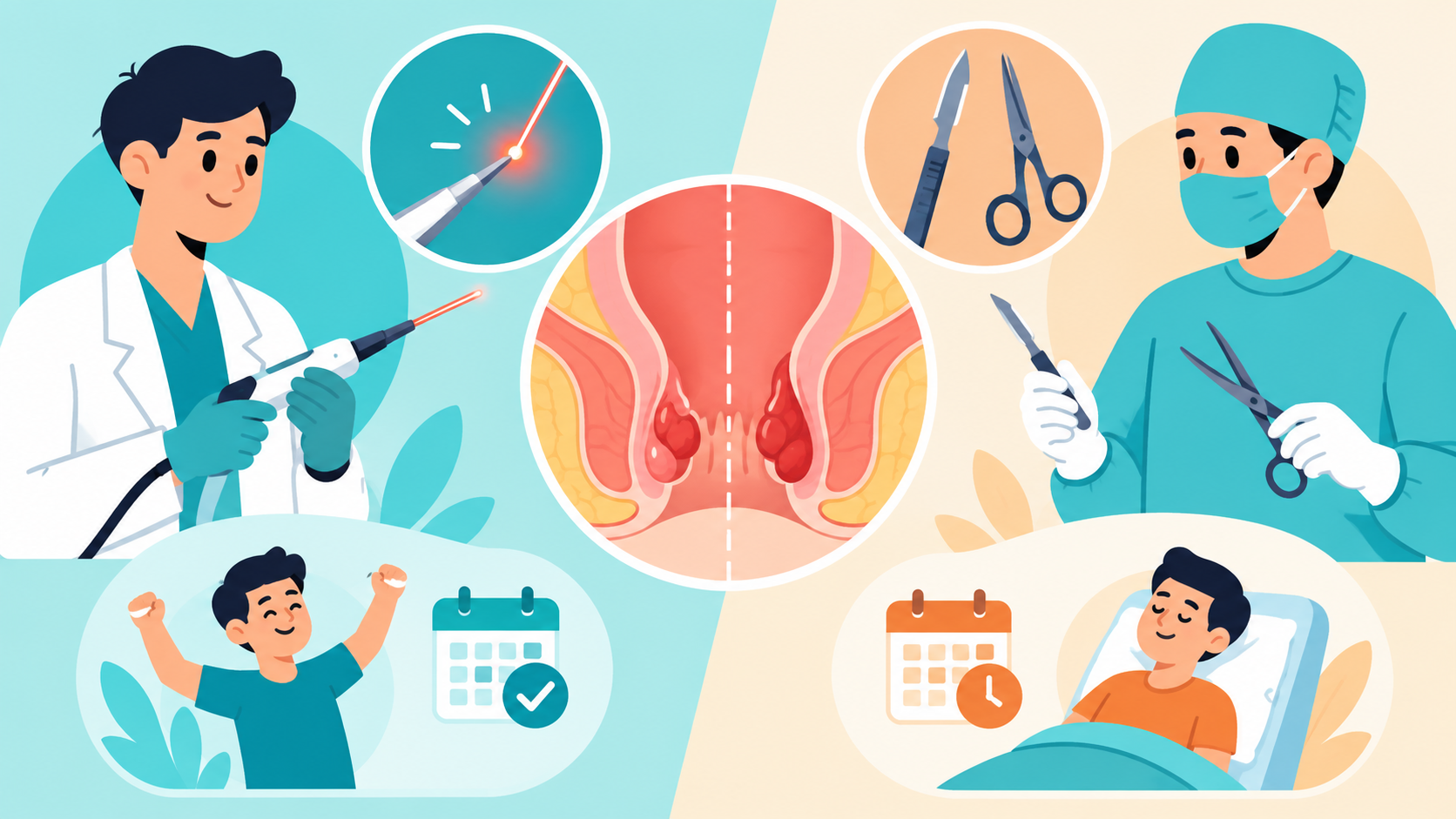
Laser treatment is one of several procedural approaches for piles. The best option depends on internal grade, external disease, prolapse, bleeding and the balance between recovery and recurrence.
“Laser piles treatment” is often advertised as a single painless solution, but the term can refer to different techniques. Some methods use laser energy inside haemorrhoidal tissue to shrink it, while conventional operations may remove enlarged tissue or reposition prolapse using another device. These procedures do not treat every pattern of piles equally.
A useful comparison should go beyond the instrument. Ask what tissue is being treated, whether there is a large external component, how prolapse will be corrected, what evidence supports the proposed method, and what the realistic risks of pain, bleeding and recurrence are. Correct diagnosis and procedure selection matter more than a marketing label.
What does “laser treatment for piles” mean?
Laser haemorrhoid procedures generally deliver controlled energy to selected haemorrhoidal tissue with the aim of reducing its blood supply and volume. Details vary between devices and techniques. Some procedures target internal cushions without excising a large wound; others may be combined with removal of skin tags or external disease.
Ask for the exact procedure name rather than accepting “laser” as a complete explanation. Laser treatment for a fistula or fissure is a different operation with a different objective. A device approved for one use should not be assumed to have the same evidence or results for another condition.
What is meant by conventional piles surgery?
Conventional surgery commonly includes excisional haemorrhoidectomy, in which problematic haemorrhoidal tissue is removed. Other established procedures can reposition prolapse or interrupt its blood supply. Each has particular indications and a different balance of postoperative discomfort, wound care and recurrence.
Excisional surgery is often considered for large external piles, substantial mixed internal-external disease, advanced prolapse or recurrence after other treatment. It may involve a more demanding early recovery, but it directly addresses tissue that a shrinkage-only technique may not remove.
Who may be suitable for each approach?
Suitability depends on internal grade, size and distribution, reducibility of prolapse, external components, skin tags, thrombosis, previous procedures, continence, bleeding risk and general health. Selected internal grade 2 or grade 3 disease may fit a less invasive approach. Grade 4 or large mixed disease may need a different operation.
A person should not be promised eligibility from a phone description alone. Examination, and sometimes anoscopy, is needed. Recurrent rectal bleeding may also require investigation before it is attributed to piles.
The surgeon should document whether the main goal is to stop bleeding, correct prolapse, remove painful external tissue or address several problems together. A technique that shrinks internal cushions may not remove external tags, while an excisional operation may treat mixed disease but create a larger wound. Continence history is important because previous childbirth injury, anal surgery or existing leakage can influence procedural planning.
Evidence should also be interpreted carefully. Studies may compare different laser devices, energy settings, grades of piles and follow-up periods, so the word “laser” alone does not predict the result. Short-term comfort and long-term recurrence are separate outcomes. Ask for procedure-specific information relevant to the surgeon’s proposed method and your disease grade.
Would you like clarity about your symptoms?
Share your main symptom, how long it has been present and whether it is getting worse. The Hegde Hospital care team can help you choose the appropriate specialist.
Pain and anaesthesia: what is realistic?
No operation can honestly be guaranteed painless. Pain varies with the amount and location of tissue treated, wounds near pain-sensitive skin, swelling, bowel movements and individual sensitivity. Less tissue excision can mean less early discomfort for selected patients, but technique alone does not predict every experience.
Procedures may use local, regional or general anaesthesia depending on the operation and patient. Discuss the planned anaesthesia, expected pain pattern, clinician-directed pain plan and whom to contact if pain is worsening rather than gradually settling.
Bleeding, infection and other risks
Possible complications across piles procedures include early or delayed bleeding, urinary difficulty, infection, swelling, narrowing, persistent skin tags, recurrence and, uncommonly, changes in continence. The probability depends on the operation, extent of disease, anticoagulant use and patient factors.
Laser energy adds technique-specific considerations such as tissue injury if energy delivery is not controlled. Conventional excision has wound-related considerations. A balanced consent discussion should cover both the risks of the proposed procedure and the consequences of undertreating large prolapse or external disease.
Recovery and return to work
A less invasive procedure may allow faster return to routine activity in appropriately selected cases, but published averages cannot promise an individual timeline. Excisional surgery often requires more time for discomfort and wounds to settle. Desk work and heavy manual work also have very different demands.
Ask about walking, sitting, driving, bowel movements, dressing or hygiene instructions, lifting and follow-up. Plan support for the first days rather than relying on a same-day recovery claim. Fever, heavy bleeding, worsening pain, inability to urinate or a rapidly enlarging swelling requires medical advice.
Recurrence and the meaning of “permanent cure”
No piles procedure can guarantee that symptoms will never return. Recurrence is influenced by residual or recurrent prolapse, the selected technique, disease extent, constipation or diarrhoea, repeated straining, pregnancy and follow-up duration. Studies may define recurrence differently, making simple percentage comparisons misleading.
Ask whether the proposed approach prioritises quicker early recovery, lower recurrence for advanced disease, treatment of external tissue or another goal. The right choice is the option whose benefits and limitations best match the patient’s anatomy and priorities.
Do you need a specialist evaluation?
Book a consultation for an examination and an individual plan based on your symptoms, medical history and test results.
How to compare a quotation or package
Cost comparisons should identify what is included: surgeon and anaesthesia fees, operating theatre, device or disposable costs, hospital stay, tests, pathology when needed and follow-up. A lower or higher price does not by itself indicate better clinical value.
Before consent, confirm the exact diagnosis, grade, procedure, alternative options, reason for choosing laser or excision, chance of conversion or additional tissue removal, recovery plan and management if symptoms recur. Avoid decisions based only on “latest,” “bloodless,” “painless” or “100% successful” claims.
Frequently Asked Questions
Is laser always better than piles surgery?
No. It may suit selected internal disease, while large external or advanced mixed piles may be better addressed by another operation.
Will laser remove external skin tags?
Not necessarily. Ask whether external tissue will be treated separately and how that changes pain, wounds and cost.
Can piles return after laser?
Yes. Recurrence can occur after any approach. Disease extent, procedure selection, bowel factors and length of follow-up affect the risk.
How should I choose a surgeon or centre?
Look for a clear diagnosis, balanced explanation of alternatives, procedure-specific consent, realistic recovery guidance and planned follow-up rather than a device-only claim.
Preparing for a specialist consultation
Before the visit, note when the symptoms began, how often they occur and whether they are linked to meals, bowel movements, lifting, pregnancy or a previous operation. Record the colour and approximate amount of any bleeding or discharge, changes in stool frequency or appearance, fever, weight change and the effect on sleep, work and daily activity. Bring earlier operation notes, discharge summaries, scan or endoscopy reports and recent blood-test results if available.
Share all current prescriptions, allergies, major illnesses, pregnancy status and any history of difficulty controlling stool or urine. Do not stop a prescribed treatment before the appointment unless the treating clinician advises it. A precise history helps the doctor decide whether examination alone is sufficient, whether a test is likely to change management and which treatment trade-offs deserve discussion. If symptoms become severe or an urgent warning sign develops while waiting for the appointment, seek prompt medical assessment instead of waiting for the scheduled visit.
Questions to ask during your consultation
- What exact laser technique are you proposing, and which tissue will it treat?
- Do I have external or grade 4 disease that needs another approach?
- What are your expected pain, bleeding and recurrence outcomes for this procedure?
- What is included in the quoted cost and follow-up plan?