
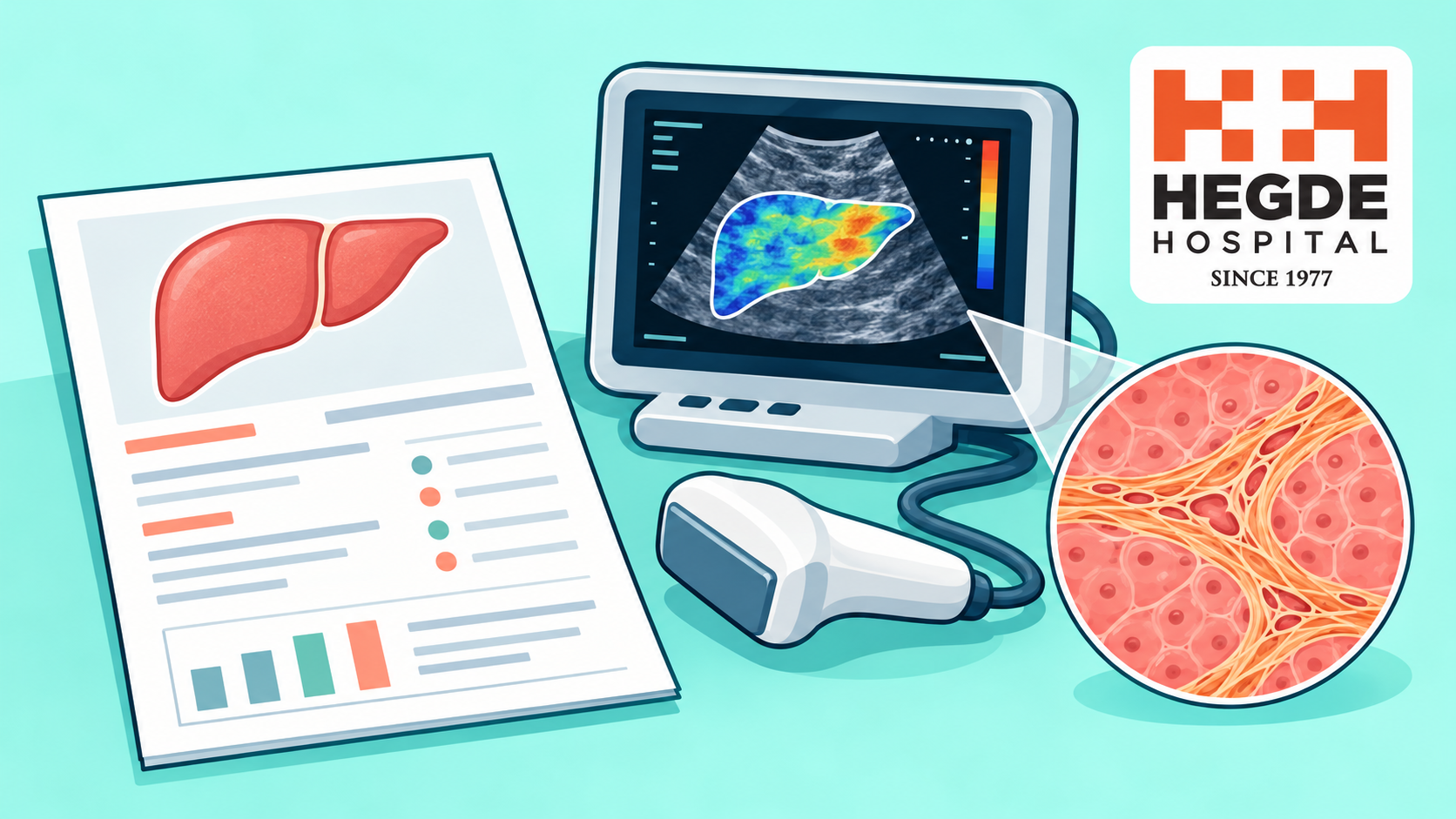
A fatty-liver ultrasound grade is different from a fibrosis stage. Understand the role and limits of blood-based assessment and stiffness testing.
An ultrasound report says “grade 1 fatty liver”, while the liver blood results look normal. Another person with the same ultrasound grade has been advised to have a stiffness test. These findings can seem contradictory because the tests answer different questions.
Fat in the liver and fibrosis, meaning scar tissue, are different features. A routine scan grade cannot tell you the stage of scarring. The purpose of a planned review is to understand your overall risk and decide whether another test would change care.
In simple terms
Blood results, a calculated fibrosis score and elastography may be used in steps to assess the possibility of advanced liver scarring. No single result should be interpreted in isolation. Normal liver enzymes do not reliably exclude significant disease, and an increased score does not by itself prove advanced fibrosis.
What does the fatty-liver scan grade actually describe?
Routine ultrasound can suggest an accumulation of fat from the appearance of the liver. Its grades describe that appearance, not a microscopic diagnosis or a fibrosis stage. A grade 1 report is not the same as stage 1 fibrosis; a grade 3 report does not automatically mean cirrhosis.
Metabolic dysfunction-associated steatotic liver disease, often shortened to MASLD, is a term used for fatty liver associated with metabolic risk. Older reports may use NAFLD. A clinician also considers alcohol intake and other causes of liver changes rather than assuming every fatty liver has the same cause.
What information is needed before ordering more tests?
Bring the full scan and blood reports with dates. The doctor reviews diabetes, waist and weight pattern, cholesterol, blood pressure, alcohol intake and existing treatments. Other liver conditions may need consideration. This is a discussion about your health history, not a judgement about appearance or habits.
The metabolic syndrome guide explains why several risk factors are considered together. People who look slim can also have relevant liver or metabolic findings. Symptoms alone are unreliable because fatty liver and fibrosis can be present without obvious discomfort.
How do the main tests differ?
| Test or result | What it contributes | Important limit |
|---|---|---|
| Liver blood tests | Clues to liver injury and function | Normal enzymes do not exclude fibrosis |
| Routine ultrasound | Liver appearance and visible fat | Its grade is not a scarring stage |
| FIB-4 score | A risk estimate using age and blood results | It is not a diagnosis or a direct scar measurement |
| Elastography | An estimate of liver stiffness | Quality and clinical context affect interpretation |
The doctor may also check for alternative reasons for abnormal results. Ordering every available scan at once is rarely the most useful starting point. Ask which unanswered question each test addresses.
What does a FIB-4 score mean?
FIB-4 is calculated using age, two liver enzyme results and the platelet count. It can help sort patients into groups needing different levels of further assessment. It does not measure liver fat, and it cannot determine every person's exact fibrosis stage.
Interpretation needs particular care in adults under 35 and in older adults, because performance and thresholds differ with age. Other illnesses or changes in the blood results can also affect the calculation. A low result reduces concern in an appropriate setting but cannot guarantee that all liver disease is absent. Do not use an online calculator as a substitute for review.
When might elastography help?
Elastography estimates stiffness using specialised ultrasound techniques or, in selected settings, MRI. A clinician may recommend it when the blood-based assessment is unclear, risk is higher or results do not fit together. It can help decide whether specialist assessment is needed.
Ask the testing centre about preparation and follow its instructions. The report should be reviewed for measurement quality as well as the number. Greater stiffness can have causes besides scarring; one reading should not trigger a self-diagnosis. If results conflict, repeat assessment or a different test may be appropriate.
Does everyone need a liver biopsy?
No. Many people can be assessed using history, blood tests and non-invasive scans. A specialist may consider a tissue sample when uncertainty remains, another diagnosis is possible or the result is likely to change management. The expected benefit and procedure risks should be discussed first.
What happens after the assessment?
Agree on who will review the results, whether specialist referral is needed and when to reassess. Follow-up depends on the initial findings, diabetes and other risks; there is no universal monthly testing timetable. Improving a liver enzyme result is encouraging, but it does not automatically prove that scarring has disappeared.
The care plan also addresses metabolic health. The type 2 diabetes review guide describes another part of that ongoing assessment. Avoid starting products advertised as liver cleansing treatments while waiting for an appointment.
When should medical evaluation be sooner?
An incidental stable scan finding usually suits a planned consultation. New yellowing of the eyes, increasing abdominal swelling or a marked change in health needs prompt review. Confusion or vomiting blood needs immediate medical evaluation; do not wait for a routine fibrosis test.
Frequently asked questions
Can normal liver enzymes rule out fibrosis?
No. Enzymes are only one part of the assessment. Risk factors, previous results and appropriate fibrosis tests may still matter.
Is grade 2 fatty liver the same as stage 2 fibrosis?
No. Routine ultrasound grades describe the appearance of fat. Fibrosis stages describe scarring and need a different assessment.
Does a high FIB-4 result confirm advanced disease?
No. It signals a need for interpretation and often another assessment. Age, the underlying blood results and other conditions affect its meaning.
Is elastography a replacement for every other test?
No. It complements the history and blood results. Its quality, limitations and agreement with other findings determine how useful it is.
How often should testing be repeated?
The interval depends on your risk and previous results. Ask for a written review plan rather than repeating scans on an arbitrary schedule.
For help understanding the report, discuss a review through the metabolic clinic and appointment service. Confirm which investigations are appropriate and available before booking them.