
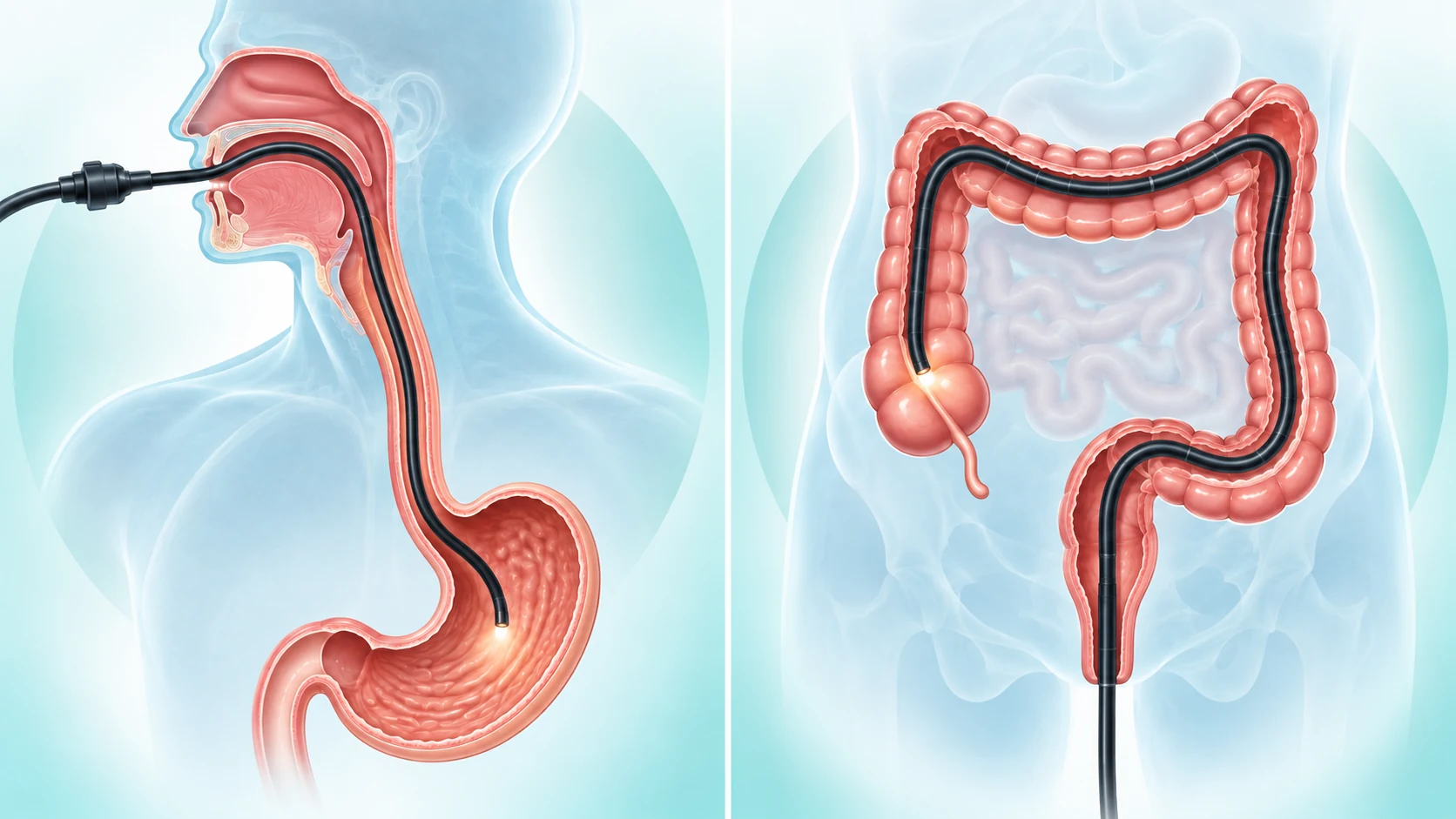
Upper endoscopy examines the food pipe, stomach and duodenum; colonoscopy examines the rectum and colon. Symptoms and the clinical question determine which test is appropriate.
Upper endoscopy and colonoscopy use a flexible camera but examine different parts of the digestive tract. Upper endoscopy passes through the mouth to view the food pipe, stomach and duodenum. Colonoscopy passes through the anus to examine the rectum and colon.
One test cannot substitute for the other simply because both use a camera. The choice depends on the source being investigated—such as swallowing difficulty or black stool for the upper tract, versus rectal bleeding or altered bowel habits for the colon.
What the condition is and why the symptom pattern matters
Both procedures can inspect lining, take biopsies and perform selected treatments. Upper endoscopy addresses upper digestive questions; colonoscopy addresses lower digestive disease and colorectal screening.
Symptoms do not always localise perfectly. Black tar-like stool often suggests an upper source, while bright-red blood may arise lower down, but clinical context determines whether one or both tests are needed. Symptoms can overlap with other conditions, so the pattern guides assessment but does not replace an examination. The duration, severity and effect on daily life help determine how quickly evaluation is needed.
Common symptoms and how they may progress
Upper endoscopy may be advised for persistent swallowing difficulty, upper pain, vomiting or suspected upper bleeding. Colonoscopy may be advised for rectal bleeding, anaemia, bowel-habit change, inflammatory symptoms, polyp surveillance or screening.
People do not always experience every feature, and symptom intensity does not reliably show how advanced the problem is. Note what triggers symptoms, whether they settle completely, and whether bleeding, discharge, swelling, altered bowel habits or weight change accompanies them. This timeline is often more useful than a single symptom description.
Causes and risk factors
The reason for testing includes diagnosis, surveillance, screening or treatment. Age, family history, prior findings and laboratory results can justify a procedure even when symptoms are limited.
A risk factor raises probability but does not confirm the diagnosis. Several factors can act together, and sometimes no clear trigger is found. The clinician should also consider previous operations, pregnancy, long-term medical conditions, family history and changes in bowel function when these are relevant to digestive endoscopy.
Would you like clarity about your symptoms?
Share your main symptom, how long it has been present and whether it is getting worse. The Hegde Hospital care team can help you choose the appropriate specialist.
Warning signs and when to seek urgent care
Active heavy bleeding, fainting, black stool with weakness, severe abdominal pain, repeated vomiting or inability to swallow liquids may require urgent hospital assessment rather than waiting for an elective procedure date.
Urgency depends on the complete clinical picture. Rapid deterioration, fainting, confusion, inability to keep fluids down, uncontrolled bleeding or severe pain with fever should not wait for a routine appointment. Persistent but less dramatic symptoms also deserve timely review when they recur, disturb sleep, restrict eating or activity, or do not improve as expected.
How doctors evaluate the problem
Before recommending a test, the doctor reviews symptoms, anaesthesia risk, heart or lung disease, prior surgery, bleeding risk and current prescriptions. The abdomen and relevant systems are examined to refine the likely source.
The purpose of evaluation is not merely to attach a label. It is to confirm the likely source, assess severity, identify complications and exclude another condition that would change treatment. Tell the doctor about prior procedures, current prescriptions, allergies and any change in bowel or bladder control, because these details can alter the safest examination and treatment plan.
Tests: which ones may be needed and why
Upper endoscopy usually requires fasting. Colonoscopy requires bowel cleansing so the lining can be seen; poor preparation can hide lesions and require repetition. Biopsy does not necessarily mean cancer is suspected—it is routinely used for several diagnoses.
Not every patient needs every test. A good investigation plan starts with a clinical question: will the result confirm anatomy, identify inflammation or bleeding, rule out a serious alternative, or change the procedure? Unnecessary testing adds cost and delay, while omitting a test that is likely to change management can lead to incomplete treatment.
Treatment options and shared decision-making
The endoscopy team provides exact preparation instructions and guidance about prescriptions. Do not independently stop prescribed blood-thinning or diabetes treatment. Transport and supervision may be needed after sedation.
Choice of treatment should reflect confirmed diagnosis, severity, anatomy, previous treatment, other health conditions and patient priorities. No responsible plan can promise a painless procedure, zero risk or permanent cure. Ask what the proposed option is intended to achieve, what it cannot correct, what alternatives exist and what would make the team change course.
Do you need a specialist evaluation?
Book a consultation for an examination and an individual plan based on your symptoms, medical history and test results.
When a procedure or surgery is considered
During upper endoscopy, the scope passes through the mouth; during colonoscopy, it advances through the colon. Sedation practices vary. Polyps can often be removed during colonoscopy, and bleeding may be treated during either procedure when appropriate.
Technique names can be confusing and marketing labels may group different operations together. The important details are what tissue is treated, whether muscle or nearby organs are at risk, the type of anaesthesia, expected hospital stay and the balance between recovery and recurrence. Consent should be specific to the proposed operation rather than a generic package description.
Recovery, follow-up and reducing recurrence
Temporary throat discomfort, gas or bloating may occur. Follow discharge instructions and seek help for severe increasing pain, fever, repeated vomiting, heavy bleeding, breathing difficulty or persistent dizziness.
A normal test applies to the area examined and the quality of preparation at that time. Future screening or surveillance still follows the recommended interval. Contact the treating team for worsening pain, fever, heavy bleeding, repeated vomiting, inability to pass urine, stool or gas, increasing swelling, or a wound that is becoming more inflamed. Planned follow-up matters because symptom relief alone does not always confirm complete healing.
Frequently Asked Questions
Can upper endoscopy see the colon?
No. It examines the upper digestive tract only.
Can colonoscopy see the stomach?
No. It begins at the anus and examines the large bowel and sometimes the end of the small bowel.
Is biopsy painful?
Biopsy of digestive lining is generally not felt as cutting pain, though the overall procedure can cause pressure or discomfort.
Can both tests be done on the same day?
Sometimes, when clinically appropriate and preparation and anaesthesia planning allow it.
Preparing for a specialist consultation
Before the visit, note when the symptoms began, how often they occur and whether they are linked to meals, bowel movements, lifting, pregnancy or a previous operation. Record the colour and approximate amount of any bleeding or discharge, changes in stool frequency or appearance, fever, weight change and the effect on sleep, work and daily activity. Bring earlier operation notes, discharge summaries, scan or endoscopy reports and recent blood-test results if available.
Share all current prescriptions, allergies, major illnesses, pregnancy status and any history of difficulty controlling stool or urine. Do not stop a prescribed treatment before the appointment unless the treating clinician advises it. A precise history helps the doctor decide whether examination alone is sufficient, whether a test is likely to change management and which treatment trade-offs deserve discussion. If symptoms become severe or an urgent warning sign develops while waiting for the appointment, seek prompt medical assessment instead of waiting for the scheduled visit.
Questions to ask during your consultation
- What question is this procedure intended to answer?
- How should I prepare and manage current prescriptions?
- Will sedation be used, and do I need an escort?
- When and how will biopsy results be explained?