
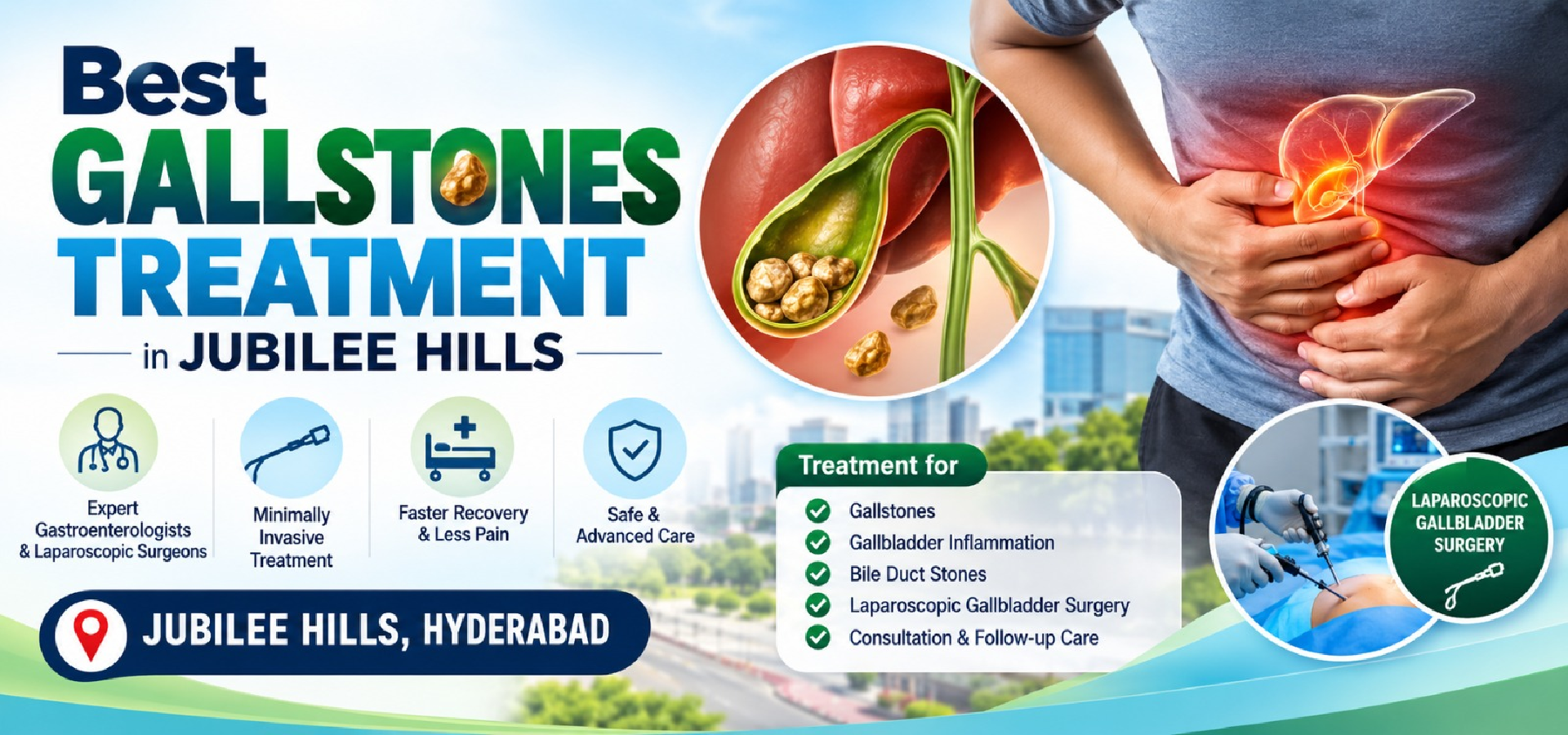
Looking For the Best Gallstones Treatment in Jubilee Hills?
Gallstones are hardened deposits that form inside the gallbladder. While some gallstones may not cause any symptoms, others can lead to abdominal pain, indigestion, nausea, vomiting and other digestive problems.
Hegde Hospital provides comprehensive diagnosis and treatment for gallstones. Patients from Jubilee Hills and surrounding areas can consult experienced General & Laparoscopic Surgeons for evaluation and an individualized treatment plan.
Call +91 7780747474Advanced Gallstones Treatment for Patients in Jubilee Hills
Gallstones may remain unnoticed for a long time, but symptomatic stones can cause repeated episodes of abdominal pain or lead to complications such as gallbladder inflammation or bile duct blockage.
At Hegde Hospital, treatment is selected according to the patient's symptoms, stone characteristics, complications and overall health. When surgery is recommended, laparoscopic cholecystectomy may be performed when clinically appropriate.
Severe or persistent upper abdominal pain, fever, jaundice or repeated vomiting should be evaluated promptly by a medical professional.
What Are Gallstones?
Gallstones are solid particles that develop in the gallbladder when substances in bile, such as cholesterol or bilirubin, become imbalanced and form stones.
Gallstones can vary in size, from tiny particles to larger stones. Some people have gallstones without symptoms and may not require immediate treatment.
When stones cause repeated symptoms, inflammation or blockage, medical evaluation is important to determine the appropriate treatment.
Common Symptoms of Gallstones
- Recurring pain in the upper right abdomen
- Abdominal pain after eating fatty meals
- Nausea or vomiting
- Indigestion or bloating
- Digestive discomfort after meals
- Repeated gallbladder attacks
- Gallbladder inflammation
- Pain that may continue for several hours
- Jaundice in cases involving bile duct blockage
Who Should Consult a Gallstones Specialist?
- People experiencing recurring upper abdominal pain
- Patients with pain after eating fatty foods
- People experiencing nausea or vomiting with abdominal pain
- Patients with gallstones detected during an ultrasound
- People experiencing repeated gallbladder attacks
- Patients diagnosed with gallbladder inflammation
- Patients with suspected bile duct blockage
- Patients advised to undergo gallbladder surgery
- Patients seeking minimally invasive gallstone treatment
How Are Gallstones Diagnosed?
Diagnosis generally begins with a medical history and physical examination. Depending on the symptoms, the doctor may recommend blood tests and imaging investigations.
An abdominal ultrasound is commonly used to identify gallstones and assess the gallbladder. CT, MRI or other imaging tests may be recommended when additional information is required or when bile duct blockage is suspected.
Gallstones Treatment Options
Treatment depends on whether the gallstones are causing symptoms, the location and characteristics of the stones, the presence of complications and the patient's overall health.
Observation
Gallstones that do not cause symptoms may not require immediate treatment. A doctor may recommend observation depending on the individual situation.
Medications
In selected cases, medications may be considered for certain types of gallstones. This approach is suitable only for specific patients and should be decided by a doctor.
Laparoscopic Gallbladder Surgery
When gallstones cause repeated symptoms, inflammation or complications, laparoscopic gallbladder removal may be recommended. The procedure is known as laparoscopic cholecystectomy.
Laparoscopic Gallbladder Surgery
Laparoscopic cholecystectomy is a minimally invasive procedure used to remove the gallbladder through small abdominal incisions using a camera and specialized surgical instruments.
Hegde Hospital's General Surgery & Laparoscopy Department provides minimally invasive gallbladder surgery for suitable patients. Laparoscopic techniques generally involve smaller incisions and may support reduced postoperative discomfort and a shorter recovery compared with conventional open surgery.
The surgeon will determine whether laparoscopic surgery is appropriate based on the patient's condition and any complications.
When Is Gallbladder Surgery Recommended?
Surgery may be recommended when gallstones repeatedly cause symptoms or when complications develop. Hegde Hospital provides cholecystectomy for gallstones and related gallbladder conditions following clinical evaluation.
- Repeated painful gallstone attacks
- Gallbladder inflammation
- Gallstones causing bile duct blockage
- Gallstone-related complications
- Selected cases of pancreatitis related to gallstones
- Other gallbladder conditions requiring surgical treatment
Why Choose Hegde Hospital for Gallstones Treatment?
- Experienced General & Laparoscopic Surgeons
- Advanced diagnostic facilities
- Modern laparoscopic surgical techniques
- Minimally invasive gallbladder treatment
- Smaller incisions and reduced scarring
- Personalized surgical treatment plans
- Comprehensive pre- and post-operative care
- Modern operation theatres
- Integrated surgical and hospital care
Recovery After Gallstone Surgery
Recovery after laparoscopic gallbladder surgery varies from patient to patient depending on the procedure, overall health and presence of complications.
Many patients can gradually return to normal activities within days to a few weeks after laparoscopic surgery, depending on their surgeon's instructions and individual recovery.
Patients should follow the recommended diet, medication, wound-care, activity and follow-up instructions provided by their medical team.
When Should You See a Doctor?
Consult a doctor if you experience recurring upper abdominal pain, digestive discomfort after meals, nausea, vomiting or previously diagnosed gallstones.
Seek prompt medical attention for severe abdominal pain, pain lasting several hours, fever, jaundice, persistent vomiting, dark urine or pale stools, as these symptoms may indicate a complication requiring urgent evaluation.
Frequently Asked Questions (FAQs)
1. What causes gallstones?
Gallstones develop when substances in bile, such as cholesterol or bilirubin, become imbalanced and form solid particles inside the gallbladder.
2. Do all gallstones require surgery?
No. Gallstones that do not cause symptoms may not require immediate treatment. Surgery may be recommended when stones cause repeated symptoms or complications.
3. What is laparoscopic gallbladder surgery?
Laparoscopic cholecystectomy is a minimally invasive procedure used to remove the gallbladder through small abdominal incisions using a camera and specialized surgical instruments.
4. How long does recovery take after gallstone surgery?
Recovery varies between patients. Many people can gradually return to normal activities within a few days to a few weeks after laparoscopic surgery, depending on their surgeon's advice.
5. Can gallstones be treated without surgery?
Some symptom-free gallstones may only require observation. In selected cases, medications may be considered. Symptomatic or complicated gallstones may require surgical treatment after specialist evaluation.
6. Where can I get gallstones treatment near Jubilee Hills?
Hegde Hospital provides gallstone evaluation and treatment for patients from Jubilee Hills and surrounding areas of Hyderabad. Call +91 7780747474 to enquire about an appointment.