
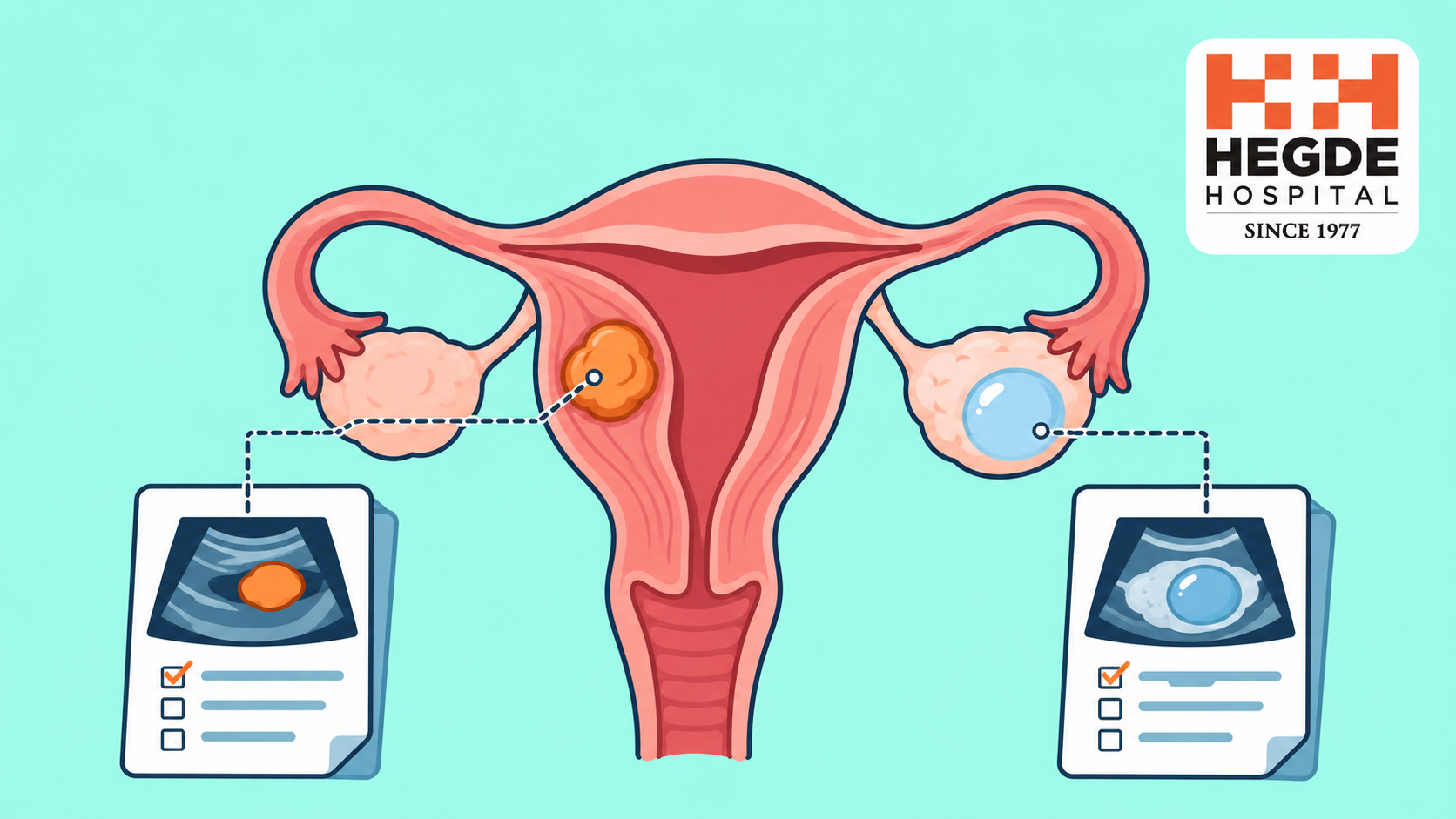
A cyst in an ovary and a fibroid in the womb are different findings. The organ, appearance, symptoms and changes over time guide the next step.
Your pelvic scan mentions a “cyst”, while a friend with similar lower-abdominal discomfort was told she has a “fibroid”. The words can sound interchangeable, especially when both are casually called a lump.
They refer to different findings. Understanding where the change is located helps you discuss the report without assuming that either word automatically means an operation.
In simple terms
An ovarian cyst is a pouch containing fluid or other tissue in or on an ovary. A uterine fibroid is a growth arising from the muscle of the womb. The ovaries sit beside the womb; they are separate organs. A person can have both findings at the same time.
A scan is interpreted alongside age, symptoms, menstrual history and previous results. Neither the word “cyst” nor “fibroid”, nor one measurement by itself, determines treatment.
Which details distinguish them?
| Report detail | Ovarian cyst | Uterine fibroid |
|---|---|---|
| Where it arises | In or on an ovary | From the muscle of the womb |
| Usual description | A pouch; appearance may be simple or more complex | Usually a solid muscular growth |
| Useful measurements | Size, appearance and which ovary is involved | Size, number and position within or around the womb |
| Why follow-up differs | Some change with the menstrual cycle; others need a different assessment | Symptoms and relation to the womb cavity affect decisions |
These are broad distinctions, not a way to diagnose yourself from a scan picture. Some findings are harder to localise, and the clinician may need more information before naming the origin confidently.
Why is location as important as size?
A fibroid growing towards the womb cavity may be relevant to bleeding even when it is not the largest one. Another may project outwards and be considered in relation to pressure symptoms. The fibroid report guide explains observation versus treatment in more detail.
For a cyst, the clinician considers its appearance as well as its measurements. A simple fluid-filled appearance and a finding with mixed contents are not interpreted in exactly the same way. “Complex” is a description requiring assessment, not a diagnosis you can settle with a search result.
Can symptoms tell me which one I have?
Symptoms overlap. Pelvic pressure, discomfort or changes in bleeding can have several explanations, and either finding may be discovered incidentally. Heavy periods can be associated with fibroids, but they should not automatically be attributed to a small scan finding without reviewing the whole history.
Record when discomfort occurs, changes in periods, pressure symptoms and how daily activities are affected. Bring earlier reports if available. Comparing the actual images and measurements is more useful than saying only that a lump has been present for years.
Will another scan or examination be needed?
Ultrasound is commonly used to assess the womb and ovaries. An abdominal or vaginal approach is chosen according to the clinical question and your circumstances, with an explanation and consent. A vaginal examination or scan is not something you must agree to without discussing concerns and alternatives.
Sometimes the clinician recommends a repeat ultrasound to check whether a cyst changes. Further imaging may help when the origin or nature of a finding remains uncertain. The interval and investigation depend on the report, symptoms and stage of life; copying another person's follow-up timetable is not appropriate.
Does either finding always need surgery?
No. Some cysts associated with the cycle settle without an operation, while others need monitoring or further assessment. Fibroids without troublesome symptoms may also be observed. Observation should include an explanation of what is being followed and when to return.
Treatment discussions consider symptoms, appearance, change over time and your preferences. Different operations address different organs and problems. Removing an ovarian cyst is not the same operation as removing a fibroid. This article concerns scan interpretation and routine pelvic assessment; individual reproductive questions need their own specialist discussion.
When should the review be sooner?
Arrange routine review to interpret an unexplained report or persistent pelvic symptoms. Increasing discomfort, ongoing troublesome bleeding or new symptoms after menopause should be discussed earlier. Sudden severe pelvic pain, fainting or severe bleeding requires urgent medical assessment rather than waiting for a planned scan.
Bring the complete report to the doctor directory or book a consultation. Ask which organ is involved, what the appearance means and what follow-up is appropriate.
Frequently asked questions
Can a cyst and a fibroid occur together?
Yes. They arise in different tissues and may both appear on the same pelvic scan. Each finding needs its own interpretation.
Is a fibroid a fluid-filled cyst?
Usually not. A fibroid is a muscular growth of the womb, whereas an ovarian cyst is a pouch in or on an ovary.
Does a larger measurement always mean surgery?
No. Size matters, but appearance, location, symptoms, change over time and the clinical assessment also influence decisions.
Does a cyst mean I have PCOD?
No. A single ovarian cyst and a diagnosis of PCOD are different matters. The diagnosis cannot be made from that word alone.
Can I wait for the next scan if symptoms change?
Do not rely on the scheduled date if symptoms worsen. Ask for earlier review, and seek urgent assessment for sudden severe symptoms.