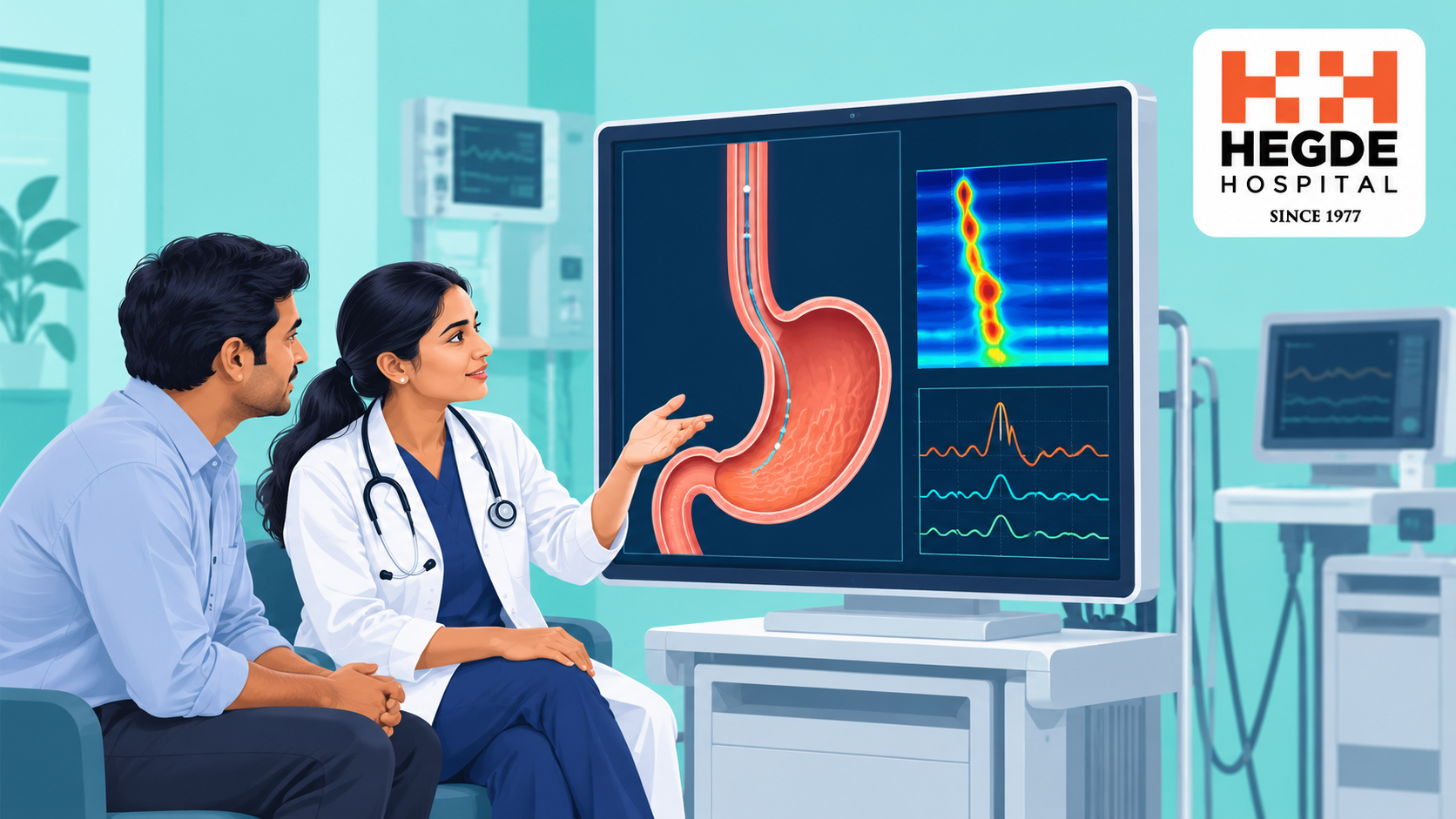
Persistent acidity does not by itself establish that surgery will help. Tests can confirm reflux and assess swallowing before an individual operation plan.
Heartburn keeps returning, and someone has suggested an operation to strengthen the barrier between your stomach and food pipe. You may wonder why the surgeon is asking for more tests when an endoscopy has already been done.
Fundoplication assessment asks two separate questions: is troublesome reflux actually responsible for the symptoms, and can the food pipe move swallowed food appropriately? Confirming the answers helps avoid an operation for a problem that surgery would not correct.
In simple terms
Fundoplication uses the upper stomach to reinforce the lower food-pipe junction. It can help selected people with confirmed GERD, but it is not the next step for everyone with acidity. Endoscopy, reflux monitoring and manometry provide different information. The specialist chooses and interprets them together rather than deciding from symptom severity alone.
When is an operation discussed?
An operation may be considered when objectively established reflux remains troublesome despite an appropriate clinician-guided plan, when particular anatomical findings matter, or when a suitable patient prefers a surgical option after discussing alternatives. A poor response to treatment is a reason to reassess the diagnosis, not automatic proof that surgery is needed.
Reflux-like symptoms can overlap with swallowing disorders and other conditions. Isolated throat symptoms or cough need particular care before being attributed to reflux. Our hiatal hernia and reflux guide explains the anatomical overlap; a small hernia alone does not decide the operation.
What does endoscopy show?
Endoscopy uses a flexible camera to examine the food-pipe and stomach lining. It can identify inflammation, narrowing or other findings that change the plan. The report and any tissue results should be reviewed rather than relying on a message saying the test was normal.
A normal-looking lining does not exclude every case of reflux. Endoscopy also does not directly measure the muscle coordination needed for swallowing. That is why a surgeon may request another type of test even after reviewing a good-quality endoscopy.
Why might reflux monitoring be needed?
Reflux monitoring measures what returns into the food pipe and can compare episodes with recorded symptoms. Depending on the question, testing may use a thin catheter or a wireless capsule. Some tests also identify non-acid reflux. Not every technique supplies exactly the same information.
Whether testing is performed while continuing or temporarily changing existing treatment depends on what has already been established. Only the treating team should give those instructions. Do not stop prescribed treatment yourself to prepare for a test.
| Investigation | Main question it can help answer |
|---|---|
| Endoscopy | What does the lining look like, and is there another explanation? |
| Reflux monitoring | Is abnormal reflux present, and how does it relate to symptoms? |
| Manometry | How do food-pipe muscles and the lower junction function? |
| Selected contrast imaging | Is additional anatomical information needed? |
What is oesophageal manometry?
Manometry measures pressure and muscle coordination in the food pipe. A thin catheter is usually passed through the nose, and the person performs instructed swallows. The team explains the preparation and what discomfort to expect. It is a functional test, not another camera examination.
Before antireflux surgery, manometry helps identify major movement disorders that could change or rule out the proposed operation. It does not diagnose GERD by itself. The result should be considered alongside symptoms, endoscopy, reflux evidence and anatomy, rather than treated as a single pass-or-fail number.
How are benefits and trade-offs discussed?
The aim is to reduce proven reflux while preserving useful swallowing function. There are different surgical approaches, including complete and partial wraps. The choice depends on the overall assessment and shared decision-making; one isolated test does not automatically dictate the same wrap for everyone.
Ask about difficulty swallowing, bloating, difficulty belching, recurrence and possible need for further treatment. Infection, bleeding and anaesthesia risks also form part of consent. Surgery cannot guarantee freedom from all future symptoms or treatment. A label such as keyhole does not remove these considerations.
The surgical gastroenterology service provides a route to discuss whether evaluation is appropriate. Public information does not establish that every test or procedure is available on site; confirm the proposed pathway with the team.
What should you bring to the review?
Bring the actual endoscopy report, any tissue results, previous reflux tests, operation records and your current treatment list. Describe heartburn and regurgitation separately, and note swallowing difficulty and the effect on eating or sleep. A brief symptom timeline is more useful than calling every discomfort acidity.
Ask what finding supports surgery, what alternatives remain and what outcome is realistic. If tests do not demonstrate the expected problem, further assessment may be more appropriate. For a separate discussion of symptoms during sleep, see our night-time reflux guide.
When does routine planning need to pause?
Progressive swallowing difficulty, unexplained weight loss or recurrent vomiting needs prompt assessment. New severe chest pain, bleeding or inability to swallow liquids needs urgent qualified evaluation. Do not assume a new serious symptom is ordinary reflux while waiting for elective tests.
For stable ongoing symptoms, book a consultation to review the diagnosis and existing reports before making a surgical decision.
Frequently asked questions
Does persistent acidity mean I need fundoplication?
No. Persistent symptoms require review of the diagnosis and previous care. Surgery is considered for selected people with appropriate objective evidence and an informed choice.
Is endoscopy enough before reflux surgery?
Often more information is needed. Reflux monitoring and manometry answer questions about reflux exposure and swallowing function that a camera test cannot fully answer.
Does manometry confirm GERD on its own?
No. It measures pressure and movement. The result is interpreted with reflux evidence and the rest of the assessment.
Should I stop treatment before a reflux test?
Only follow instructions from the team arranging the test. Preparation differs according to the clinical question and your existing diagnosis.
Can surgery guarantee that reflux never returns?
No. Many suitable patients benefit, but symptoms can persist or recur and further care may be needed. Discuss realistic benefits and swallowing-related risks before consenting.