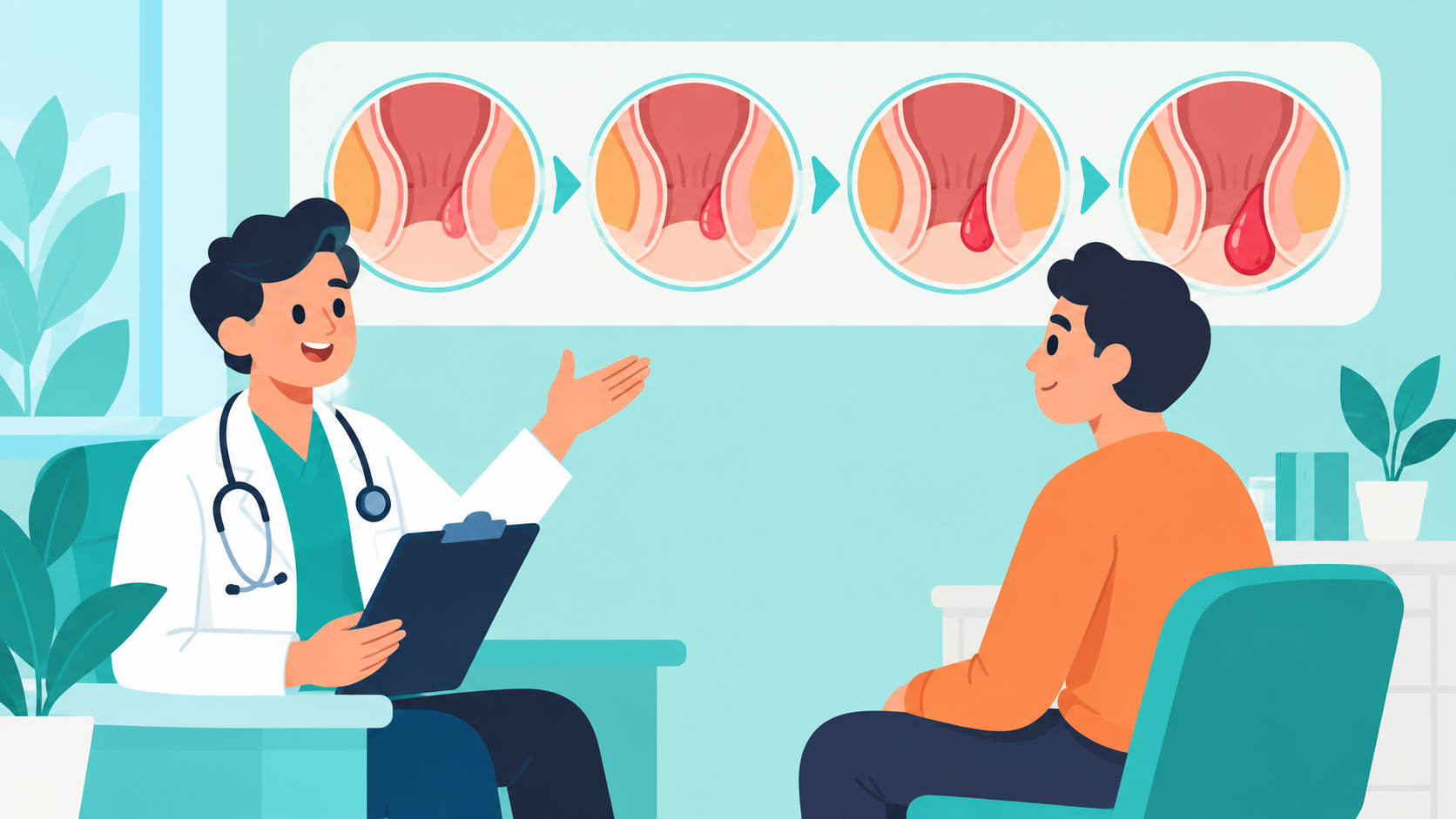
Internal piles are graded by how far they prolapse, from grade 1 without visible prolapse to grade 4 that remains outside. Grade supports treatment planning, but bleeding, discomfort and examination findings also matter.
Piles grades describe the prolapse of internal haemorrhoids. Grade 1 piles remain inside the anal canal, grade 2 come out during straining and return on their own, grade 3 need to be pushed back, and grade 4 remain outside and cannot be reduced. This grading system does not apply in the same way to external piles.
Grade alone does not decide treatment. A person with lower-grade piles may have troublesome recurrent bleeding, while another person with prolapse may have limited symptoms. A surgeon considers bleeding, anaemia, hygiene problems, discomfort, thrombosis, bowel habits, examination findings, previous procedures and patient priorities before recommending a plan. The same grade can therefore lead to different recommendations for different people.
Piles grades 1 to 4 at a glance
| Grade | What happens | Common concerns |
|---|---|---|
| Grade 1 | Enlarged internal piles do not prolapse outside | Bleeding, irritation or no symptoms |
| Grade 2 | Prolapse during stool or straining, then return spontaneously | Bleeding, mucus, itching or intermittent lump |
| Grade 3 | Prolapse and require manual reduction | Persistent lump, hygiene difficulty, bleeding |
| Grade 4 | Remain prolapsed and cannot be pushed back | Swelling, discharge, skin irritation, clotting or severe discomfort |
The grade can change over time and may look different during an examination when the patient is not straining. The clinician combines history with examination rather than assigning a grade from symptoms alone.
What symptoms can occur at each grade?
Bright-red bleeding can occur at any internal grade and does not necessarily increase in direct proportion to prolapse. Lower grades often present with bleeding alone. With increasing prolapse, people may notice a lump during bowel movements, mucus staining, itching, difficulty cleaning or a feeling of incomplete evacuation.
Internal piles are located above a less pain-sensitive part of the anal canal, so uncomplicated internal piles may not cause severe pain. Marked pain suggests thrombosis, strangulation of prolapsed tissue, an anal fissure, abscess or another diagnosis. External piles are separate from the internal grading system and may form a painful clot.
What makes piles worsen or recur?
Repeated straining, hard stool, prolonged time on the toilet and frequent loose stool can all aggravate haemorrhoidal tissue. Pregnancy, obesity, ageing and activities that repeatedly increase abdominal pressure may contribute. These factors do not mean the person caused the condition; haemorrhoids are normal anatomical cushions that become symptomatic when enlarged or displaced.
A detailed bowel history matters because treating prolapse without addressing persistent constipation or diarrhoea can leave an important driver unchanged. The clinician may also review work patterns, pregnancy, previous colorectal procedures and symptoms that suggest a separate digestive disorder.
Would you like clarity about your symptoms?
Share your main symptom, how long it has been present and whether it is getting worse. The Hegde Hospital care team can help you choose the appropriate specialist.
When bleeding requires more than a piles examination
Visible piles do not prove that all bleeding comes from piles. Colon or rectal inflammation, polyps, tumours, diverticular disease and upper digestive bleeding can produce blood in stool. Medical review is especially important when blood is mixed through stool, bleeding is recurrent, stool is dark or black, or symptoms occur with anaemia, weight loss, abdominal pain or altered bowel habits.
Urgent assessment is required for heavy ongoing bleeding, fainting, severe weakness, black tar-like stool, rapidly increasing painful swelling or fever. Depending on age, family history, screening status and symptom pattern, the doctor may recommend blood tests or colonoscopy in addition to an anal examination.
How piles are examined and graded
The doctor asks whether a lump comes out, whether it returns by itself and whether it has to be pushed back. Inspection can identify external disease, skin irritation, fissure or prolapse. A gentle rectal examination assesses tenderness and other abnormalities. Anoscopy or proctoscopy allows the internal haemorrhoidal cushions to be seen directly.
Grading can be difficult when prolapse is intermittent. Describing what occurs during a bowel movement is therefore useful. Photographs taken for personal medical discussion may sometimes help when the swelling is absent in clinic, but they do not replace examination or exclude another source of bleeding.
When non-surgical treatment may be enough
For many grade 1 and selected grade 2 cases, the first plan focuses on clinician-guided bowel regulation and correcting repeated straining or loose stool. Treatment is based on the cause and severity rather than a generic product. Persistent bleeding still requires review even when symptoms initially improve.
Office procedures can be considered for suitable internal piles when symptoms continue. They are not interchangeable with operations for large external components or advanced prolapse. The number of cushions involved, current anticoagulant use, other medical conditions and previous treatment influence suitability.
When a procedure or surgery is considered
A procedure may be discussed when bleeding, prolapse, mucus, hygiene difficulty or repeated flare-ups continue despite an appropriate initial plan. Grade 2 and some grade 3 internal piles may be suitable for an office-based procedure. Larger grade 3, grade 4, mixed internal-external disease or recurrent symptoms after previous treatment may require an operation.
Options differ in how they control blood supply, reposition prolapsing tissue or remove haemorrhoids. No method is best for every patient. More extensive removal may address large disease but can involve greater early discomfort; less invasive methods may offer a different recovery profile and recurrence trade-off. The surgeon should explain this for the exact anatomy.
The decision is also shaped by how symptoms affect everyday life. Repeated bleeding may contribute to iron-deficiency anaemia; prolapse may interfere with cleaning, exercise or work; and external disease may cause swelling that an internal-only procedure will not address. Previous treatment, pregnancy plans, anticoagulant use, continence and anaesthesia risk should be included in shared decision-making. Asking why a particular procedure matches both the grade and the external component is more useful than choosing treatment by a device name.
Do you need a specialist evaluation?
Book a consultation for an examination and an individual plan based on your symptoms, medical history and test results.
What recovery depends on
Recovery depends on whether treatment is office-based or surgical, the number and size of piles, external involvement, anaesthesia, general health and the physical demands of work. Fixed promises such as “back to normal in one day” are not reliable for every procedure.
Before leaving, obtain written guidance about bowel regulation, eating and drinking, wound or dressing care, walking, driving, work and follow-up. Increasing pain, fever, heavy bleeding, inability to pass urine or a tense worsening swelling should be reported promptly. A planned review helps assess healing and any remaining prolapse or bleeding.
Frequently Asked Questions
Can grade 1 piles become grade 4?
Prolapse can progress in some people, but progression is not inevitable. Symptom review and bowel management can reduce aggravating factors.
Do all grade 3 piles need surgery?
No. Anatomy, bleeding, external components, previous treatment and patient preference influence the decision. Some may be suitable for office treatment, while others benefit from surgery.
Are grade 4 piles dangerous?
They are not automatically life-threatening, but persistent prolapse can clot, swell, ulcerate or become difficult to clean. A surgical assessment is appropriate.
Can piles grade be diagnosed from bleeding alone?
No. Grade describes prolapse, not the amount of blood. Examination is needed, and other causes of bleeding may need investigation.
Preparing for a specialist consultation
Before the visit, note when the symptoms began, how often they occur and whether they are linked to meals, bowel movements, lifting, pregnancy or a previous operation. Record the colour and approximate amount of any bleeding or discharge, changes in stool frequency or appearance, fever, weight change and the effect on sleep, work and daily activity. Bring earlier operation notes, discharge summaries, scan or endoscopy reports and recent blood-test results if available.
Share all current prescriptions, allergies, major illnesses, pregnancy status and any history of difficulty controlling stool or urine. Do not stop a prescribed treatment before the appointment unless the treating clinician advises it. A precise history helps the doctor decide whether examination alone is sufficient, whether a test is likely to change management and which treatment trade-offs deserve discussion. If symptoms become severe or an urgent warning sign develops while waiting for the appointment, seek prompt medical assessment instead of waiting for the scheduled visit.
Questions to ask during your consultation
- Are my piles internal, external or mixed, and what grade are the internal piles?
- Does my bleeding require blood tests or colon evaluation?
- Which office procedures or operations fit my anatomy?
- What are the expected recovery and recurrence trade-offs for each option?